Showing posts with label grammar. Show all posts

Tuesday, August 12, 2014

Let's go on a noun hunt

You can shoot as many as you want.

A sentence needs one noun and one verb. That's it. Next time you write a sentence count the nouns in it.

For some reason we like to turn verbs and adjectives into nouns. This is called nominalization. Maybe we think it sounds more important.

It doesn't; it just confuses. Compare these two passages from George Orwell's Politics and the English Language:
I returned and saw under the sun, that the race is not to the swift, nor the battle to the strong, neither yet bread to the wise, nor yet riches to men of understanding, nor yet favour to men of skill; but time and chance happeneth to them all.
Here it is in modern English:
Objective considerations of contemporary phenomena compel the conclusion that success or failure in competitive activities exhibits no tendency to be commensurate with innate capacity, but that a considerable element of the unpredictable must invariably be taken into account.
Academics fall prey to nominalization. So do business writers. Perhaps it's because business writing is often about abstract concepts.
An accreditation analysis was conducted of the performance level of the administration of the senior executive compensation disbursement mechanism.
This would be much clearer by inserting some prepositions and verbs:
the mechanism for disbursing compensation to senior executives
You can make your writing a lot stronger by counting the nouns in a sentence and getting rid of as many as possible. Here's an example from Helen Sword, who teaches at the University of Aukland:
The proliferation of nominalizations in a discursive formation may be an indication of a tendency toward pomposity and abstraction.

The sentence above contains no fewer than seven nominalizations, each formed from a verb or an adjective. Yet it fails to tell us who is doing what. When we eliminate or reanimate most of the zombie nouns (tendency becomes tend, abstraction becomes abstract) and add a human subject and some active verbs, the sentence springs back to life:

Writers who overload their sentences with nominalizations tend to sound pompous and abstract.
Don't be pompous and abstract.

Monday, May 19, 2014

When the passive voice can be used by you

One of the easiest ways to improve your writing is to use the active voice wherever possible. It's amazing what that change can do.

But not every use of the passive is wrong. First, let's be clear what the passive voice is.
The noun that would be the object of an active sentence (such as, Our troops defeated the enemy) appears as the subject of a sentence with passive voice (e.g., The enemy was defeated by our troops).
Why it is a weak construction can be seen in its use by politicans. "Mistakes were made" doesn't tell us who made them, which is the point of saying it that way.

However, we should use the passive voice on certain occasions. Here are some.
  1. The actor is unknown:
    The cave paintings of Lascaux were made in the Upper Old Stone Age. [We don't know who made them.]
  2. The actor is irrelevant:
    An experimental solar power plant will be built in the Australian desert. [We are not interested in who is building it.]
  3. You are talking about a general truth:
    Rules are made to be broken. [By whomever, whenever.]
  4. You want to emphasize the person or thing acted on. For example, it may be your main topic:
    Insulin was first discovered in 1921 by researchers at the University of Toronto. It is still the only treatment available for diabetes.
So don't let Microsoft Word's grammar cop bully you every time.

Wednesday, March 12, 2014

Is it shall or will?

The bottom line: use will for everything, and you'll be safe from the grammar police.

If, however, you want to emphasize your intention, use shall. A famous example of this is in John Kennedy's inaugural address:
Let every nation know, whether it wishes us well or ill, that we shall pay any price, bear any burden ...
There are some other rules -- if you happen to live upstairs at Downton Abbey or plan to meet the queen.

Here's how they say it:
In British English, there has been a traditional rule that shall is to be used when the subject is in the first person (I or we), and will in other cases. In practice this rule is commonly not adhered to by any group of English speakers, and many speakers do not differentiate between will and shall when expressing futurity, with the use of will being much more common and less formal than shall. In many specific contexts, however, a distinction still continues.
So it's a rule, but not a rule. Got it? Fowler allows as how the rule "is so complicated that those who are not to the manner born can hardly acquire it."

Winston Churchill surely knew the rule. I don't know if he was honoring it when he promised:
"We shall go on to the end. We shall fight in France, we shall fight on the seas and oceans, we shall fight with growing confidence and growing strength in the air, we shall defend our island, whatever the cost may be. We shall fight on the beaches, we shall fight on the landing grounds, we shall fight in the fields and in the streets, we shall fight in the hills; we shall never surrender ... "
His use of shall with the first person we is proper. An American, however, hears an emphasis. I suspect he did as well. As it should be.

Thursday, January 2, 2014

So is it he, she or it?

But you should follow the rules.
When I was growing up and trying to avoid the wrath of Miss Schindler, my eighth-grade English teacher, I learned that subjects and verbs must agree. I also learned that "he" was acceptable for both boys and girls, just as "mankind" was acceptable for both genders.

In fact, that was the rule. An arbitrary rule, to be sure, but isn't every grammar rule arbitrary? These days we're so liberated and daring that we declare that it's okay to break a rule, because, you know, some white guy who is now dead just made it up.

That's fine with me, but we need some rules so that we can understand what other people are saying. That's hard enough as it is, since so many people are saying just pure nonsense.

It's like English TV shows: if the actors have a heavy accent and speak too quickly, I have a hard time following them. Unconventional grammar is like an unfamiliar accent. People trying to use a second language get hung up on slang and idioms, the rule-breaking stuff that people just make up.

That's today's sermon. I'll now pass the collection plate.

So what are we to do with this he/she business? Some women object to the constant use of "he," because, well, there are she-women out there, too.

That's okay by me, except that it's problematic for a writer. Constantly switching between he and she is clunky. Substituting "they" for he or she just doesn't sound right to anyone instructed as I was. Writers and editors abhor "he or she" or "s/he," because they are, well, wordy. And stupid.

The Oxford Dictionaries are firmly politically correct: use "he or she" and "they." If you go that way, cite Oxford. Nobody ever got fired for hiring IBM.

I recently came across a rousing discussion of this in a Linked In group called Linkeds & Writers. I suppose you have to join the group to follow along.

These are people in the trenches earning a living (or trying to) by cleaning up your writing. I'm going to quote a few of them to give you some suggestions. I'm only going to quote women.
"I'm also big on using plurals: customers, not customer. Also, to use your example: "The contact person/representative who returns a customer's calls will already have that individual's history." Yes, sometimes it means being a little wordier than you'd like, but it resolves the problem." ~ Debra
So she's avoiding it by writing around it, which is what I'm guessing most writers and editors try to do. It's not always possible.
"It seems to me that the first choice should always be to avoid 3rd-person-singular pronouns entirely, and build sentences using tricks like Debra's to avoid leaving holes where the reader would expect such pronouns. Plurals work in many other cases, and named individuals in most of the rest. 
"Switching genders back and forth is so apt to lead to problems. Though alternating pronoun genders is often recommended as a way to approach the [3rd-person-singular pronoun] issue, it actually tends to exacerbate the problem because it sets a sort of mental calculator going in the reader’s mind -- Are the two sexes really portrayed in equal numbers and with equal emotional loading? -- that reduces the mental circuitry available for the topic actually under discussion even when, as rarely happens, the answer is yes." ~ Hilary
I like that, because it suggests that all our worrying may just be annoying the reader, who is surely going to notice our contrivances more than our political correctness.
"What a cumbersome load of PC crap! Switching genders (to satisfy the client's PC angle) creates only cluttered and confusing writing. Stick with "he" or "they" and be done with it. Submitting to a ridiculous gender aspect, particularly in business writing where people generally really don't care and would rather read clarity and simplicity of expression than cumbersome ping-ponging of pronouns, well, you and the client enjoy the written mess you're creating." ~ Alison
There you go. Just do it that way. Great writers have been using "they" in this context forever. Shakespeare is often cited. Shakespeare is often cited for just about anything anybody wants to do. So if you go this route, cite Shakespeare.

Nobody every got fired for quoting Shakespeare at the water cooler.

Monday, October 21, 2013

Grammar up with which I will not put!

What's with the hair, dude?
A snobbish English teacher was sitting in an Atlanta airport coffee shop waiting for her flight back to Connecticut, when a friendly Southern belle sat down next to her.

"Where y’all goin’ to?" asked the Southern belle.

Turning her nose in the air, the snob replied, "I don’t answer people who end their sentences with prepositions."

The Southern belle thought a moment, and tried again.

"Where y’all goin’ to, bitch?"

That one is from a blog post at the Oxford Dictionaries. If you want a good lesson on prepositions, that post by Catherine Soanes is your go to post.

For the rest of us, here's a distillation regarding ending a sentence with them.
The word ‘preposition’ ultimately derives from Latin prae ‘before’ and ponere ’to place’. In Latin grammar, the rule is that a preposition should always precede the prepositional object that it is linked with: it is never placed after it. According to a number of other authorities, it was the dramatist John Dryden in 1672 who was the first person to criticize a piece of English writing (by Ben Jonson) for placing a preposition at the end of a clause instead of before the noun or pronoun to which it was linked. 
This prohibition was taken up by grammarians and teachers in the next two centuries and became very tenacious. English is not Latin, however, and contemporary authorities do not try to shoehorn it into the Latin model. Nevertheless, many people are still taught that ending a sentence or clause with a preposition should be avoided.
I'd like to point out that both John Dryden and Ben Jonson are dead. Reason enough to avoid fighting over grammar.

Friday, August 30, 2013

Speaking of dangling

Being just too easy, I commit the crime of dangling modifiers more often than I like.

Needing help, Ben Yagoda, the most helpful professor of English and journalism at the University of Delaware, comes to my rescue:
In a class, I once assigned students to review a consumer product. One student chose a bra sold by Victoria's Secret. She wrote: 
Sitting in a class or dancing at the bar, the bra performed well…. Though slightly pricey, your breasts will thank you.
Now I'm just guessing, but I think Yagoda chose this example in an effort to appeal to the men slouching on the back row.
The two sentences are both guilty of dangling modifiers because (excuse me if I'm stating the obvious), the bra did not sit in a class or dance at the bar, and "your breasts" are not slightly pricey. 
Danglers are inexplicably attractive, and even good writers commit this error a lot... in their first drafts.
Told you.
Here's a strategy for smoking these bad boys out in revision. First, recognize sentences that have this structure: 
MODIFIER-COMMA-SUBJECT-VERB.
Then change the order to: 
SUBJECT-COMMA-MODIFIER-COMMA-VERB. 
If the result makes sense, you're good to go. If not, you have a dangler. So in the first sentence above, the rejiggered sentence would be: 
The bra, sitting in a class or dancing at a bar, performed well. 
Nuh-uh. The solution here, as it often is, is just to add a couple of words: 
Whether you're sitting in a class or dancing at the bar, the bra performs well.
Being a good way to remember this rule, I will now end this post.

Monday, May 20, 2013

It may be that you need the word "that"

Now you do.
A lot of people leave it out, and I'd rather hear their fingernails on a blackboard.

Here from Professor Malcolm Gibson at the University of Kansas is the rule:
After a verb of attribution (said, stated, announced, disclosed), the word “that” often can be omitted with no loss of meaning:

He said (that) he was tired. No need for "that." Better to omit.

But if the words that follow “said” (or any verb of attribution) might be mistaken as objects of the verb, omitting “that” might lead the reader down a false trail:

The governor announced his new tax plan would be introduced soon.

Here “that” is needed after "announced. Without it, the reader's first impression is that the plan itself has been put forth. Remember that even momentary confusion provides readers with a handy place to stop — and that's not good. A reader should never have to pause to understand what the writer (or speaker) is trying to convey. If that happens too often (and once may be once too often), a reader stops reading.
The decision to use or omit “that” is not always a simple one, Gibson says. Sometimes it's a judgment call. But don't let your desire to lop off unnecessary words lead you into bad judgment. As a rule of thumb in questionable cases, remember: Using “that” is never really wrong, though it may be unnecessary; omitting “that” in some cases indeed may be wrong.

Thursday, April 18, 2013

Here's a quick improve for your writing

When I was a cub reporter on the night shift at The AP in New Orleans I'd show up and find notes from my editor about my work the night before.

One evening the note said, "Is 'host' a verb?"

Well, as Hillary said, what does it really matter?

Actually, it's a noun and a verb. But the question was legitimate. One way we can clean up our language -- and make ourselves more easily understood -- is to stop using verbs as nouns. For one thing, it just sounds stupid.
“Do you have a solve for this problem?” “Let’s all focus on the build.” “That’s the take-away from today’s seminar.” Or, to quote a song that was recently a No. 1 hit in Britain, “Would you let me see beneath your beautiful?”
See what I mean?

Henry Hitchings nails it:
If you find these sentences annoying, you are not alone. Each contains an example of nominalization: a word we are used to encountering as a verb or adjective that has been transmuted into a noun. Many of us dislike reading or hearing clusters of such nouns, and associate them with legalese, bureaucracy, corporate jive, advertising or the more hollow kinds of academic prose. Writing packed with nominalizations is commonly regarded as slovenly, obfuscatory, pretentious or merely ugly.
He speculates on why we do this:
Why say “solve” rather than “solution”? One answer is that it gives an impression of freshness, by avoiding an everyday word. To some, “I have a solve” will sound jauntier and more pragmatic than “I have a solution.” It’s also more concise and less obviously Latinate (though the root of “solve” is the Latin solvere).
Well, read his very fine article and just don't do it. And enjoy this:

Monday, March 11, 2013

Write like you know what you're doing

Correctly using like and as will let your discerning readers or listeners know that you know. It will also make your message clearer.

Good instruction in this can be found in The New York Times' blog on the language, After Deadline. Philip Corbett writes:
The word like plays many grammatical roles. The one that raises a usage issue is its sense as a preposition meaning similar to. In that guise it can introduce only a noun or a pronoun: He deals cards like a riverboat gambler. If in doubt about the fitness of a construction with like, mentally test a substitute preposition (with, for example): He deals cards with a riverboat gambler. If the resulting sentence is coherent, like is properly used. 
But when like is used to introduce a full clause — consisting of subject and verb — it stops being a preposition and becomes a conjunction. Traditional usage, preferred by The Times, does not accept that construction:He is competitive, like his father was. Make it as his father was, or simply like his father. If the as construction (although correct) sounds stiff or awkward, try the wayinstead: He is competitive, the way his father was. 
In other cases, if like fails the preposition test, as if may be needed: She pedaled as if [not like] her life depended on it. 
When like is used correctly as a preposition, it faces another test. The items linked by like must be parallel, and therefore comparable. Do not write Like Houston, August in New York is humid. That sentence compares August to Houston, not what its author meant. Make it Like Houston, New York is humid in August.
Like, you know?

Monday, February 11, 2013

Everyone should check their grammar

One monkey.
Consider these sentences:
Every student aced his project. 
Many professors make every student buy their own books.
Everyone will be able to decide for himself whether or not to have an abortion.
 Can "they" be singular?

We're certainly trying hard to make it so. This is done so as not to offend women by using "he" to stand for either gender, which is what I learned in school umpteen years ago.

Those of us who don't like "they" being singular try "he or she," or we write around it: All the students aced their projects.

No one is really happy with their solution.

On The Economist's Johnson blog, the estimable Robert Lane Greene throws everything he has into the argument that a singular "they" is okay. Including the fact that Chaucer, Shakespeare, the King James translators, Swift, Byron, Austen, Goldsmith, Thackeray, Shaw, Herbert Spencer and others used it that way.

I wouldn't be caught dead in that crowd.

When I wrote for The Associated Press back in the olden days the title "Ms." came into being. Cautious about changing its style rules, The AP instructed us to say "Ms. Woman, who prefers that designation." That is just so awkward that I did anything to avoid it. I preferred to not quote a woman than add that silliness to my poetry.

So I'm going to stick with "they" as a plural, because the alternative just grates on my ear. That's my reason, and I won't hear of anything different.

Monday, February 4, 2013

Keep your subject and verb close

Together forever.
A simple way to add clarity to your writing is to keep the subject and verb of a sentence close together. When they are separated by a lot of other words, readers have to hunt for the words that belong together. This can be especially confusing if the extra words include other verbs. 
Bad.  Good writers, no matter how much they like to interrupt themselves with a verbal diversion, imagine a magnet between subject and verb. 
Good.  Good writers imagine a magnet between subject and verb, no matter how much they like to interrupt themselves with a verbal diversion.
Here's another example, this one from, ironically, the federal government.
The natural word order of an English sentence is subject-verb-object. This is how you first learned to write sentences, and it's still the best. When you put modifiers, phrases, or clauses between two or all three of these essential parts, you make it harder for the user to understand you. 
Consider this long, convoluted sentence: 
If any member of the board retires, the company, at the discretion of the board, and after notice from the chairman of the board to all the members of the board at least 30 days before executing this option, may buy, and the retiring member must sell, the member's interest in the company. 
In essence, the sentence says: The company may buy a retiring member's interest. All the rest of the material modifies the basic idea, and should be moved to another sentence or at least to the end of the sentence.  
Remember boys and girls, Big Brother is watching you write.

Thursday, January 31, 2013

Mistakes are made by the passive voice

Few things will bring more clarity to your writing than the active voice.

In the active voice, a subject verbs an object. In the passive voice, an object is verbed by a subject.
Active: I rode the bicycle. Four words. "I" is the most important thing. 
Passive. The bicycle was ridden by me. Six words. "Bicycle" is the most important thing.
So what's wrong with the passive? For one thing, as we know from listening to politicians, it can be used to conceal things.
"Mistakes were made."
By whom?

A second objection is that the passive voice requires more work on the part of the reader. The WhiteSmoke blog illustrates this with a movie reference.
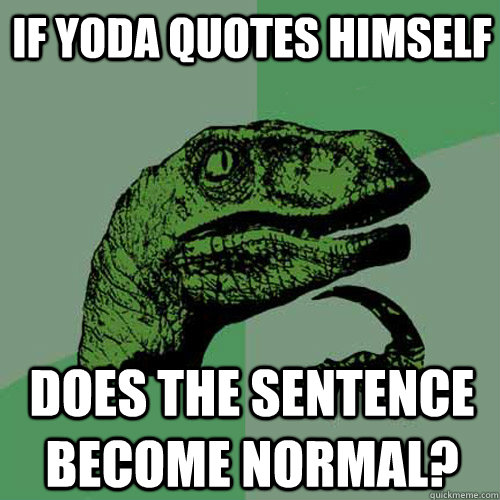
If you've seen the movie Star Wars,  think of how Yoda speaks. He inverts the order of subjects and objects, and his sentences are a little jumbled and hard to understand at first.

Yoda Quote: "Named must your fear be before banish it you can."

Yoda uses a different order than regular Subject Verb Object English. He uses a mix of patterns, including VOS. Either way, Yoda's words are a bit confusing at first. They require additional thought. You don't want the same for your writing; the goal is clarity and boldness, not ambiguity or lengthy contemplation.
There are perfectly good reasons to use the passive -- perhaps you don't know who or what the subject is, or you want to emphasize the object. But make those excepptions to the rule.

Friday, January 11, 2013

Those annoying independent clauses

I frequently see independent clauses -- clauses that can stand alone as a sentence -- joined together haphazardly.

There are three basic ways to do it: use a comma followed by a conjunction, a semicolon alone, or a semicolon followed by a sentence modifier. A sentence modifier is a word or phrase that is not the subject or predicate but adds to the meaning of the sentence.

The Simply Study Guides website provides these examples:
Incorrect: The delivery boy knew he carried strange cargo, but still ventured off unafraid.

Correct: The delivery boy knew he carried strange cargo, but he still ventured off unafraid.

Incorrect: My math teacher doesn't know how to lecture, she should have remained a student.

Correct: My math teacher doesn't know how to lecture; she should have remained a student.
 [In my mind this previous example, known as a comma splice, is one of the most egregious grammatical errors. Okay, it just annoys me ear.]
Incorrect: Gregor has not changed physically; but has given himself an excuse to separate himself from the pain of previous experiences.

Correct: Gregor has not changed physically; however, he has given himself an excuse to hide from the pain of previous experiences.
You might ask yourself, as well, whether the clauses ought to be joined in the first place. Perhaps two sentences is better. Does the meaning require joining? Does it contribute to a more pleasing style? What will most help the reader grasp the meaning?

Having trouble recognizing independent clauses? The Tongue Untied has some examples, and offers this slightly different insight:
The independent clause is the main idea of the sentence. It is not dependent on another clause for meaning and context. 
Avoid using the description that the independent clause can "stand by itself" or "makes sense by itself."Many dependent clauses, when removed from the context of the sentence, make sense on their own. Nonetheless, they are dependent on the rest of the sentence for meaning and should not be evaluated outside of the sentence.
You really don't want to get between two grammarians. 

Thursday, October 11, 2012

A post which you should read

E.B. White, spinning in his grave.
The title of this post is incorrect, in my opinion. The word which, according to the rule I follow, should only be used with nonrestrictive relative clauses, i.e., clauses that impart a mere extra bit of information.

For restrictive clauses -- those with a crucial bit of definition -- the preferred word is that.

Robert Lane Green, an international correspondent for The Economist, is a descriptivist in matters of the language and so he thinks the title of this post is just swell.
To pick on Strunk and White, they prescribe a rule on “which” and “that” to introduce relative clauses: “which” must introduce a “nonrestrictive” relative clause (a mere extra bit of information). Only “that” can introduce a “restrictive” clause (a crucial bit of definition). You agree with White that “The lawn mower which is broken is in the garage” should have “that,” not “which.” However, even White doesn’t agree with White. As the linguist Geoff Pullum noticed, White used “which” in the “wrong” way in his essay “Death of a Pig”: “the premature expiration of a pig is, I soon discovered, a departure which the community marks solemnly on its calendar.” White would probably say he slipped. I’d console him; no, he didn’t. It’s a fine sentence from a fine American writer.
Green is a frequent contributor to The Economist's excellent blog on writing, Johnson, but, heavens man, are you going to take on Strunk and White and risk a lightning strike?

Furthermore, in the afterlife you'll have to deal with Miss Schindler, who taught me grammar in the eighth grade and who taught my father before me and who would have given me a resounding slap on the shoulder had I confused which and that.

Which I didn't.