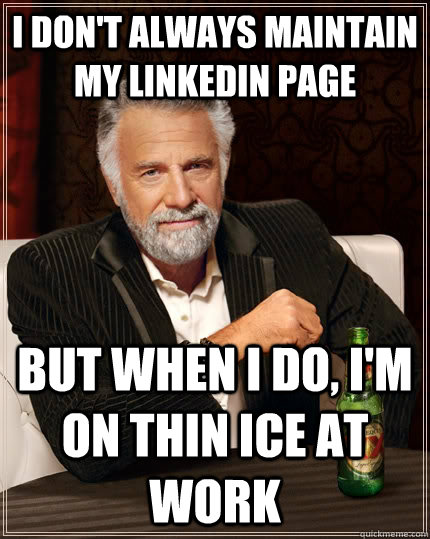
Or on your resume, or in the john, or in the backyard talking to your chickens.
You already know this because you've read all those profiles using them and you just want to gag yourself with a spoon, right?
Do this little test: read five LinkedIn profiles at random and see if you have really learned something about the person. If you haven't, it may be due to their use of bad words.
That's right, these words are just bad, bad, bad. Don't even think about going near them.
Another test: see how many of these words appear in a person's summary. Pass me that spoon, please.
Aaron Taube at Business Insider has collected these.
1. I — Who else's profile would it be?
2. Me — See above.
3. My — See above.
4. She — Only narcissists speak in the third person.
5. He — See above.
6. Salary — Never list it unless an employer asks.
7. Go getter — Jargon.
8. Synergy — Jargon.
9. People pleaser — Jargon.
10. Self starter — Jargon.
11. Strategic — Overused.
12. Creative — Overused.
13. Effective — Overused.
14. Expert — Only if you really are.
15. Driven — Overused.
16. Innovative — Overused.
17. Analytical — Overused.
18. References — If they want them, they'll ask. Otherwise you're just wasting space.
19. w/ — Spell it out to look professional.
20. Extensive — Overused and unnatural.
21. Ninja — Annoying/meaningless.
22. Diva — Annoying/meaningless.
23. Dedicated — Boring.
24. Detail oriented — Who isn't?
25. Passionate — If you are, it will come through without your explicitly saying so.
26. Entrepreneurial — Overused.
27. Skill set — Overused.
28. Dynamic — What does this even mean?
29. Intense — Can make you sound unpleasant to work with.
30. People person — They'll know when you come in for an interview.
31. Problem solver — Avoid unless you have clear-cut examples.
32. Team player — Overused.
33. Track record — Your track record should be apparent in your profile.
Sign into LinkedIn and see what you can do. This stuff isn't easy.
Showing posts with label resumes. Show all posts
Thursday, August 21, 2014
Thursday, August 8, 2013
Time to get realistic about your resume
| This is realistic. |
Newsflash: They're still here, just like email, which has been declared dead as often as resumes. I think both are still around because they are "good enough" technology. We know how to use them, and we don't have to learn something new like Google Plus.
I've been editing my current resume for 15 years or more, and studying resume writing all the while, and I've got some pretty hardened opinions about the things. The look of it is important: the reader's eye has to be able to take your life in in about 15 seconds. You need good typography and lots of white space to accomplish that. See that photo? As the person on the other side of the desk I used to sit at a table in HR and slog my way through piles like that. Think I spent an hour with each one?
Another thing. A resume has uses beyond landing that coveted deputy assistant VP job at Really Big Corp. you actually believe you want. It is often useful if you're selling your services as an independent contractor or freelancer. Your profile on Linked In has the form of a classic chronological resume, and I sometimes use that.
Marie Raperto has some ideas as well, and hers are worth paying attention to. She's a New York-based recruiter in the communications field. She has good list of 10 pointers, from which I'll draw a few:
No functional resumes. Functional resumes are definitely out of favor for a number of reasons — they were overused, they are used to hide information, and they are hard to read. Hiring managers scan resumes and scanning a functional resume does not work. Candidates should also avoid using functional resumes to answer online job ads as they do not fit the Applicant Tracking System format used by most companies.
I agree, although I'm sympathetic to a hybrid functional/chronological format. I once used that with a client who wanted to change fields. It was necessary to show how what she knew in one area could be applied in the new area she wanted to enter.
Fluff phrases. Demonstrated leadership, years of success, unflappable, history of relationships, liaison, meaningful are all useless words. Think managed, supervised, achieved, promoted.Puh-leeze. If you've got those words in your resume, please hire a jaded editor like me and let him or her drag you off your cloud. How many "energetic, results-oriented professionals" are wandering around out there?
Objectives. The ‘objective’ of a resume is to get a job. Instead of an ‘objective,’ use a ‘summary’ to highlight your background as it pertains to a particular job.If you've been around the bend a few times as I have, you need to find a way to highlight the really good stuff hiding on page two or three. A summary can do that. I have several versions of my resume that differ only in the summary. I aim the summary directly at the job being advertised. I copy and paste the job description and qualifications right onto the Word document of my cover letter to address each one. I do the same with my resume summary, although not in such detail.
You can find more advice from Ms. Raperto here.
Subscribe to:
Posts (Atom)