Showing posts with label questions. Show all posts

Monday, June 9, 2014

What to ask yourself before you write

I have a bad habit of jumping into a piece to see what happens, with nary a thought up front. I don't recommend it. Do as I say, not as I do.

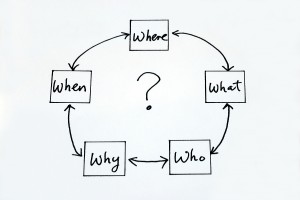
A good place to start thinking about what you want to write is the five fundamental questions (here and here).

Closely related to these questions, and perhaps their ancestor, is the concept of stasis. The term stasis means a state of equilibrium. Allen Brizee at Purdue University explains:
Stasis theory is a four-question, pre-writing (invention) process developed in ancient Greece by Aristotle and Hermagoras. Later, the stases were refined by Roman rhetoricians, such as Cicero, Quintilian, and Hermogenes. Working through the four stasis questions encourages knowledge building that is important for research, writing, and for working in teams. Stasis theory helps writers conduct critical analyses of the issues they are investigating.
Specifically, stasis theory asks writers to investigate and try to determine:
  • The facts (conjecture)
  • The meaning or nature of the issue (definition)
  • The seriousness of the issue (quality)
  • The plan of action (policy)
Brizee suggests a number of questions to ask under each category. Worth a look. 
It is important to achieve stasis with the issue you are investigating. Put another way, if you are trying to solve the parking problem on your campus, it will not do anyone any good to suggest that students stop smoking. The solution has nothing to do with (does not achieve stasis with) the issue at hand.
It might be instructive to examine the next journal article you read for evidence that the writer has asked these critical questions.

Wednesday, May 14, 2014

Putting the five fundamental questions to work

When you ask the five fundamental questions -- who, what, where, when and why -- you have the elements of a story.

This works whether you're on deadline in a newsroom or trying to get a child to sleep. But will it work in the sophisticated idea journalism of business?

As an experiment, I went to the strategy+business website. This is the journal of stragegy&, formerly Booz & Co., which created the term "thought leadership" in the early 90s. I contributed to the journal some years ago.

I selected an article at random. The title "Cut Your Company’s Fat but Keep Some Slack" caught my eye, and I knew what it would be about -- a company can be too lean. Would these experts in thought leadership use the five fundamental questions in constructing the article?

The article begins with an anecdote about a hospital in Missouri. Anecdotes are little stories, so I'm feeling confident. Who: doctors and administrators. What: chaos. Where: surgical suite. When: all day. Why: no spare operating rooms.

Whew! I was right. But there's more.

The anecdote uses three paragraphs. The fourth graf is what we called "the fat graf" in The Associated Press Newsfeatures department, where I camped out for four years. It's fat because it takes extra space to explain to the reader what the article is about and why he should read it. Jack Capon, our brilliant editor back then, demanded that the fat graf come no later than third.

The strategy-business editors use one sentence to explain what's up: "Many systems require slack in order to run smoothly."

Got it. Then they're back into telling stories. Some words about crowded highways, which we all understand. Then, shifting to the second person, a discussion of you and your assistant and your calendar.

Note that the editors wait til the 10th graf to use the buzzword "lean and mean." Up til then, they label the concept "slack." I'd say this are okay jargon, because ordinary people use these terms.

Instead of abstract concepts, the writer has been telling stories. Just answering the five fundamental questions in different ways. We're having fun reading, and we're getting the idea.

You won't go wrong copying this approach.

Monday, April 14, 2014

Asking the right questions

I keep six honest serving-men
(They taught me all I knew);
Their names are What and Why and When
And How and Where and Who.
~ Rudyard Kipling

Asking these questions has become known as "the Kipling method" after the little ditty in his Just So Stories.

When you are wrestling with the often abstract concepts in business and economics, these are excellent questions to bring you down to earth.

In fact, they've been used for centuries to get at the essence of something. In the 19th Century, Prof. William Cleaver Wilkinson popularized the "Three Ws" – What? Why? What of it? – as a method of Bible study:
"What? Why? What of it?" is a plan of study of alliterative methods for the teacher emphasized by Professor W.C. Wilkinson not as original with himself but as of venerable authority. "It is, in fact," he says, "an almost immemorial orator's analysis. First the facts, next the proof of the facts, then the consequences of the facts. This analysis has often been expanded into one known as "The Five Ws:" "When? Where? Who? What? Why?" Hereby attention is called, in the study of any lesson: to the date of its incidents; to their place or locality; to the person speaking or spoken to, or to the persons introduced, in the narrative; to the incidents or statements of the text; and, finally, to the applications and uses of the lesson teachings.
How can you use this idea? David Straker offers some good advice. He suggests expanding the basic questions:
One approach with this is to use the questions in a particular order to help guide you through a sequence of thought towards a complete answer, such as:
  • What is the problem?
  • Where is it happening?
  • When is it happening?
  • Why is it happening?
  • How can you overcome this problem?
  • Who do you need to get involved?
  • When will you know you have solved the problem? 
Try it the next time you're wrestling with a difficult concept.

Thursday, March 27, 2014

Answering the right questions

There's a story here.
Reporters are taught to ask the "5 Ws": who, what, where, when, why. It would be tidier if "how" started with a "w," but we're stuck with it.

This series of questions, also used in police work and elsewhere, can be useful to someone writing about business and economics, even the sometimes abstract "thought leadership."

These questions serve several purposes. One, they are the basics of a story. Two, they anchor what we're trying to say in specifics.

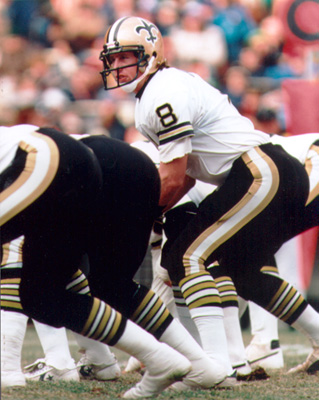
Let me illustrate. I began my career in the New Orleans bureau of The Associated Press. It was our duty to report on home games of the Saints football team. We had a formula for starting these stories. Before I show it, let me suggest several ways to begin a story about a professional football game:
  • The first game of American football, which evolved from rugby football, was played in 1869 between Rutgers and Princeton, two schools in New Jersey.
  • As with other football teams, the New Orleans Saints sent 11 men on to the field to take on 11 men from another team and seek to score more points.
Huh? Now here is how we would write it:
  • NEW ORLEANS -- Archie Manning threw three touchdown passes, including a 57-yarder, to lead the New Orleans Saints to a 43-14 victory over the Dallas Cowboys on Sunday in the Superdome.
That's a story. It's got a hero in it. He overcomes opposition and achieves his goal. We know who, what, where, when and how. The why is unspoken but understood.

Think about your writing. Can you take that clever, abstract, in the clouds idea and create a story using these questions? I guarantee your readers will appreciate the effort.