Showing posts with label writing. Show all posts

Wednesday, October 29, 2014

Walk, then write

Walking on a Country Road, Valerie Jeanne Frischmann
I  often read through the material I will use to write something for a client and then go for my walk. It's a two-mile trek down a quiet side road, beside which there is a stream for a bit.

The ideas enter the thought scrum in my head and take their lumps. I know my work is better for having walked, although I don't charge for the time. A good bit of the work happens on the road.

Here are some things we know about walking and thinking:
What is it about walking, in particular, that makes it so amenable to thinking and writing? The answer begins with changes to our chemistry. When we go for a walk, the heart pumps faster, circulating more blood and oxygen not just to the muscles but to all the organs—including the brain. Many experiments have shown that after or during exercise, even very mild exertion, people perform better on tests of memory and attention. Walking on a regular basis also promotes new connections between brain cells, staves off the usual withering of brain tissue that comes with age, increases the volume of the hippocampus (a brain region crucial for memory), and elevates levels of molecules that both stimulate the growth of new neurons and transmit messages between them.
Moreover, walking in the country is best.
A small but growing collection of studies suggests that spending time in green spaces—gardens, parks, forests—can rejuvenate the mental resources that man-made environments deplete. Psychologists have learned that attention is a limited resource that continually drains throughout the day. A crowded intersection—rife with pedestrians, cars, and billboards—bats our attention around. In contrast, walking past a pond in a park allows our mind to drift casually from one sensory experience to another, from wrinkling water to rustling reeds.
It's said that William Wordsworth—whose poetry is filled with tramps up mountains, through forests, and along public roads—walked as many as a hundred and eighty thousand miles in his lifetime, which comes to an average of six and a half miles a day starting from age five.

Wonder if he charged.

Thursday, October 9, 2014

Getting out of Dodge

You probably give more thought to how you start an article or a speech than you do its ending. But you need to think of both, and in nearly all cases they should relate to each other.

Something positive happens in the reader's mind when at the end he encounters a reference to something from the beginning. For some reason, this recognition gives credence to what you have written. Perhaps simply because it's familiar. Perhaps because the reader feels good about himself for having recognized the repetition.

You can do this in a perfunctory way: quote Shakespeare in the beginning and again in the end, for example. That's not going to buy you much.

Better to do it subtly, to give the reader even more satisfaction from seeing what you're doing. So if you begin with a reference to Sherlock Holmes, you can end with terms like sleuth or mystery or clue or put on your cloak to create an echo of the beginning. No need to mention the old boy by name.

But there's more. In a short story or novel, the ending resolves the conflict the hero dealt with. The reader is relieved that it's over. He celebrates with the hero, if, indeed, the knight prevailed over the dragon. The ending is cathartic.

If your piece is more than just a report on second quarter earnings, you are probably dealing with some kind of conflict. If you aren't, look for it. It may well be the conflict between what you know and what your reader doesn't know. You're bringing your reader to a new point of understanding. In the end, you resolve this.

(And maybe you ought to look at those quarterly numbers as a piece of tension to be resolved. They do tell a story, after all.)

You've been making a  case, laying out your evidence, and now you close in for the kill. You tie it all together, and if you do it well the reader has an epiphany, which is pleasurable.

In his Gettysburg Address, Abraham Lincoln sets up the tension: "But, in a larger sense, we can not dedicate, we can not consecrate, we can not hallow this ground."

In the end, he resolves it: "It is rather for us to be here dedicated to the great task remaining before us — that from these honored dead we take increased devotion to that cause for which they gave the last full measure of devotion — that we here highly resolve that these dead shall not have died in vain — that this nation, under God, shall have a new birth of freedom — and that government of the people, by the people, for the people, shall not perish from the earth."

His words leave us with a profound and sacred challenge.

Tuesday, September 16, 2014

Will your writing last 100 years?

Held up well.
Most academics spend much of their time writing but aren't as good at it as they should be, Michael C. Munger, chairman of political science at Duke University, says.

In The Chronicle of Higher Education, in an article  titled "How To Write Less Badly," he offers some insight that is applicable far beyond the ivy-covered red bricks.

This article pulled me up short. I've been cranking it out for so many years I think I may have lost sight of the reason I got into this game in the first place.

Here he is:
1. Set goals based on output, not input. "I will work for three hours" is a delusion; "I will type three double-spaced pages" is a goal. After you write three pages, do something else. If later in the day you feel like writing some more, great. But if you don't, then at least you wrote something.

2. Find a voice; don't just "get published." James Buchanan won a Nobel in economics in 1986. One of the questions he asks job candidates is: "What are you writing that will be read 10 years from now? What about 100 years from now?" Someone once asked me that question, and it is pretty intimidating. And embarrassing, because most of us don't think that way. We focus on "getting published" as if it had nothing to do with writing about ideas or arguments. Paradoxically, if all you are trying to do is "get published," you may not publish very much. It's easier to write when you're interested in what you're writing about.

3. Give yourself time. Many smart people tell themselves pathetic lies like, "I do my best work at the last minute." Look: It's not true. No one works better under pressure. Sure, you are a smart person. But if you are writing about a profound problem, why would you think that you can make an important contribution off the top of your head in the middle of the night just before the conference?

Writers sit at their desks for hours, wrestling with ideas. They ask questions, talk with other smart people over drinks or dinner, go on long walks. And then write a whole bunch more. Don't worry that what you write is not very good and isn't immediately usable. You get ideas when you write; you don't just write down ideas.

The articles and books that will be read decades from now were written by men and women sitting at a desk and forcing themselves to translate profound ideas into words and then to let those words lead them to even more ideas. Writing can be magic, if you give yourself time, because you can produce in the mind of some other person, distant from you in space or even time, an image of the ideas that exist in only your mind at this one instant.
There's more at the link.

Thursday, June 19, 2014

Should you go with the flow?

Flow.
It's hard enough to write without having to worry about whether you're "in the zone" or "in the flow." If you're fretting that, you're doing it wrong.

The concept of flow is quite real, but it has a specific meaning. It's not some blast of inspiration from above. Wait for that to write and you'll slip from this life at your keyboard, covered in cobwebs.

The chap who came up with this concept is a Hungarian psychologist with an impossible name -- Mihaly Csikszentmihalyi (pronounced Cheek-sent-muh-hy-ee). Here's how he sees it:
According to Csikszentmihalyi, flow is completely focused motivation. It is a single-minded immersion and represents perhaps the ultimate experience in harnessing the emotions in the service of performing and learning. In flow, the emotions are not just contained and channeled, but positive, energized, and aligned with the task at hand. The hallmark of flow is a feeling of spontaneous joy, even rapture, while performing a task although flow is also described (below) as a deep focus on nothing but the activity – not even oneself or one's emotions.
To achieve flow it is suggested that:
  • One must be involved in an activity with a clear set of goals and progress. This adds direction and structure to the task.
  • The task at hand must have clear and immediate feedback. This helps the person negotiate any changing demands and allows them to adjust their performance to maintain the flow state.
  • One must have a good balance between the perceived challenges of the task at hand and their own perceived skills. One must have confidence in one's ability to complete the task at hand.
One writer suggests:
Perhaps the two most important ingredients for flow are motivation and ability in the person. If you can’t paint worth a lick, no amount of motivation will let you abandon conscious effort, because you just aren’t good enough. Conversely, a world-class author won’t produce anything of value if she has no desire to even sit at the computer, let alone write. The more you have of both, the easier reaching flow becomes.
The lesson, then, is to discover where what you love doing overlaps what you are capable of doing well.

More insight for writers comes from Romanian journalist Simina Mistreanu, who interviewed seven award-winning journalists and came up with this insights:
Reporting and being part of other people’s lives triggers flow. These journalists find purpose in shedding light onto difficult, often heart-wrenching issues. That connection — between mission and joy — was echoed by the seven accomplished writers who use longform narratives to cover sensitive social issues. 
I don't know that Csikszentmihalyi explicitly included a sense of mission as necessary for flow. It makes sense, however, in that how a writer views his work informs his passion and motivation. In other words, his writing has meaning.

In the end, the only way to find your zone is to sit down and start writing. "I write when I'm inspired," Peter De Vries said, "and see to it that I'm inspired at nine o'clock every morning."

Tuesday, May 27, 2014

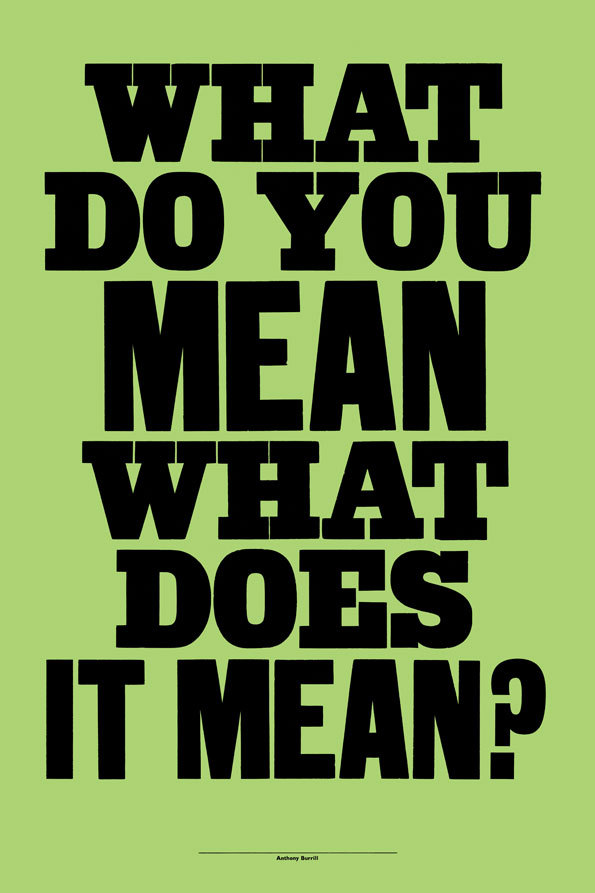
What do you mean?

Writer to editor.
“Writing is an instrument for conveying ideas from one mind to another; your job as a writer is to make the reader grasp your meaning readily and precisely. Do you always say just what you mean? Do you yourself always know just what you mean?”

~ Ernest Gowers

Gowers was the author of Plain Words, which has recently been revised by his daughter, Rebecca Gowers. Michael Skapinker, a Financial Times columnist, calls it "still the best book on English and how to write it."

Before we can transmit meaning to the reader, we must say what we mean. That requires that we know just what we mean.

Writing helps us to discover that. This is why writing is really rewriting. The first go is where we discover what it is we're thinking. The second draft is where we attempt to explain what it is we're thinking. It's where we discover that free floating thoughts don't translate easily to linear words on paper.

A final draft cleans it all up: Is this the wrong word? Will a reader get this?

That's when it's ready for an editor, who will point out that we're kidding ourselves.

Friday, March 14, 2014

The three duties of a writer

Nabokov.
Vladimir Nabokov was a Russian novelist who rose to international prominence as a writer of English. In his Lectures on Literature he writes that a writer has three roles.
There are three points of view from which a writer can be considered: he may be considered as a storyteller, as a teacher, and as an enchanter. A major writer combines these three — storyteller, teacher, enchanter — but it is the enchanter in him that predominates and makes him a major writer.

To the storyteller we turn for entertainment, for mental excitement of the simplest kind, for emotional participation, for the pleasure of traveling in some remote region in space or time. 
A slightly different though not necessarily higher mind looks for the teacher in the writer. Propagandist, moralist, prophet — this is the rising sequence. We may go to the teacher not only for moral education but also for direct knowledge, for simple facts… 
Finally, and above all, a great writer is always a great enchanter, and it is here that we come to the really exciting part when we try to grasp the individual magic of his genius and to study the style, the imagery, the pattern of his novels or poems.
He is writing about fiction, but these traits can be applied to writing or speaking about business and economics. Our audiences would like a good story, and they are listening or reading to learn something.

If we can offer these, and also inspire -- enchant them, if you will -- we stand a chance to persuade them.

Thursday, January 16, 2014

What I don't know would fill books

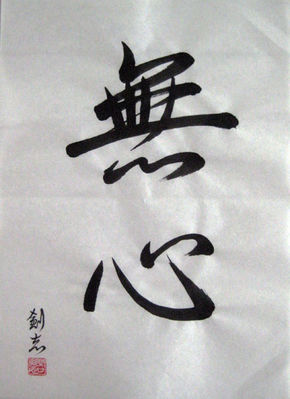
Mushin.
A friend of mine recently told me that learning to say "I don't know" was very hard, especially in the corporate world, where we are expected to fake to make it to 5 o'clock.

When he finally learned to admit it that he didn't know everything, my friend said, he felt, well, enlightened. At least liberated.

I've been reading about Japanese calligraphy, and I'm playing with the idea mastering it is somewhat akin to "I don't know." The masters of this art, or shodō, are said to seek a "no mind state" before they pick up the brush
To write Zen calligraphy with mastery, one must clear one's mind and let the letters flow out of themselves, not practice and make a tremendous effort. This state of mind was called the muslin ("no mind state") by the Japanese philosopher Nishida Kitaro. It is based on the principles of Zen Buddhism, which stresses a connection to the spiritual rather than the physical.
Here is more on mushin.
The term is shortened from mushin no shin, a Zen expression meaning the mind without mind and is also referred to as the state of "no-mindness". That is, a mind not fixed or occupied by thought or emotion and thus open to everything. 
Mushin is achieved when a person's mind is free from thoughts of anger, fear, or ego during combat or everyday life. There is an absence of discursive thought and judgment, so the person is totally free to act and react without hesitation and without disturbance from such thoughts. At this point, a person relies not on what they think should be the next move, but what is felt intuitively.
I hesitate to attempt an application of this concept, especially to the matter of fact world of business writing. That would seem to violate the principle.

However, these thoughts arise, particularly for the business of thought leadership.

1. We all carry around a burden of beliefs and assumptions, and we aren't really aware of them. For example, do you assume that people act rationally? How does this influence your writing? Do you believe that capitalism is best when unfettered? How does this affect what you choose to write about?

2. If we wish to be genuine leaders of thought, we won't get there by repeating everything we think we know. We have to clear our minds of all that. We have to start afresh.

3. If we start from a position of humility -- I know very little -- we are more likely to arrive at a new insight, as opposed to a rearrangement of the thoughts of others. I guess I should be grateful for all I don't know.

Good writing is the fresh expression of a fresh idea. An empty mind seems a good starting point.

Tuesday, January 14, 2014

The sloppiness of modern prose

George Orwell illustrates how poor our writing is:

"Here is a well-known verse from Ecclesiastes:
I returned and saw under the sun, that the race is not to the swift, nor the battle to the strong, neither yet bread to the wise, nor yet riches to men of understanding, nor yet favour to men of skill; but time and chance happeneth to them all.
"Here it is in modern English:
Objective considerations of contemporary phenomena compel the conclusion that success or failure in competitive activities exhibits no tendency to be commensurate with innate capacity, but that a considerable element of the unpredictable must invariably be taken into account.
"This is a parody, but not a very gross one. It will be seen that I have not made a full translation. The beginning and ending of the sentence follow the original meaning fairly closely, but in the middle the concrete illustrations -- race, battle, bread -- dissolve into the vague phrases “success or failure in competitive activities.” This had to be so, because no modern writer of the kind I am discussing -- no one capable of using phrases like “objective considerations of contemporary phenomena” -- would ever tabulate his thoughts in that precise and detailed way. The whole tendency of modern prose is away from concreteness. 

"Now analyze these two sentences a little more closely. The first contains forty-nine words but only sixty syllables, and all its words are those of everyday life. The second contains thirty-eight words of ninety syllables: eighteen of those words are from Latin roots, and one from Greek. The first sentence contains six vivid images, and only one phrase (“time and chance”) that could be called vague. The second contains not a single fresh, arresting phrase, and in spite of its ninety syllables it gives only a shortened version of the meaning contained in the first. Yet without a doubt it is the second kind of sentence that is gaining ground in modern English. 

"I do not want to exaggerate. This kind of writing is not yet universal, and outcrops of simplicity will occur here and there in the worst-written page. Still, if you or I were told to write a few lines on the uncertainty of human fortunes, we should probably come much nearer to my imaginary sentence than to the one from Ecclesiastes."

Tuesday, October 22, 2013

If you can't write, pick up the phone

Galbraith: Pick up the phone.
Here's a tactic that will get you going if you're in a rut and at the same time make your writing stronger.

Pick up the phone.

As a business writer at The Associated Press back in the Dark Ages, I found myself working on a series of articles about coffee prices with a fellow reporter who came up to New York from Washington, where he covered the CIA and other spooky things.

We were going to prove that there was a conspiracy to raise coffee prices. After several weeks of tramping around odd parts of Manhattan chasing down coffee brewers, who wouldn't tell us anything, my colleague allowed as how covering the top-secret CIA was a lot easier.

I digress. I was sitting at my typewriter one morning (I told you it was the Dark Ages) stuck on what to type next. My editor wandered by, took one glance, sized me up, and scolded, "You just can't pick up the phone, can you?"

His point: if you don't know where to go next, get some more information. If you can't write, report.

You can't write your way around a problem. You have to read more or ask someone to get around it. The payoff is that the more facts and data you get, the better your insight into the topic and the more precise and concrete your writing. Specific is always better than general. Real is better than theoretical.

I was reminded of this when I came across an article written in 1978 -- about the same time I discovered that coffee prices go up because of market forces, duh -- by the economist  John Kenneth Galbraith. He had been asked to teach college students about writing, and he was pondering what he might say.

Here's his version of "pick up the phone":
George Bernard Shaw once said that as he grew older, he became less and less interested in theory, more and more interested in information. The temptation in writing is just the reverse. Nothing is so hard to come by as a new and interesting fact. Nothing is so easy on the feet as a generalization. I now pick up magazines and leaf through them looking for articles that are rich with facts; I do not care much what they are. Richly evocative and deeply percipient theory I avoid. It leaves me cold unless I am the author of it. My advice to all young writers is to stick to research and reporting with only a minimum of interpretation. And especially this is my advice to all older writers, particularly to columnists. As the feet give out, they seek to have the mind take their place.
It's good advice for young and old.

Friday, October 18, 2013

To write well, daydream well

Jessica Lahey, an author and former teacher, writes in The Atlantic about the lost art of daydreaming and its value for our children.

She quotes psychologist Scott Barry Kaufman:
The rewards include self- awareness, creative incubation, improvisation and evaluation, memory consolidation, autobiographical planning, goal driven thought, future planning, retrieval of deeply personal memories, reflective consideration of the meaning of events and experiences, simulating the perspective of another person, evaluating the implications of self and others’ emotional reactions, moral reasoning, and reflective compassion.
If it's good for children, why isn't it good for adults? Well, it is.

On a 30-minute walk on my road in the evening I often create an entire 750-word column in my mind. It needs a bit of sharpening, of course, but it's there. It springs forth seemingly out of nowhere. I've always marveled at this, but it should be no surprise. A mind at rest from the daily toil is free to play.

Sigmund Freud makes the connection for us:
Might we not say that every child at play behaves like a creative writer, in that he creates a world of his own, or, rather, rearranges the things of his world in a new way which pleases him? The creative writer does the same as the child at play. He creates a world of phantasy which he takes very seriously — that is, which he invests with large amounts of emotion — while separating it sharply from reality.
Of course, you might want to first close your office door.

Monday, September 30, 2013

Why writing well is important

“Writing is thinking. To write well is to think clearly. That's why it's so hard."
~ David McCullough

Good writing accomplishes two things. It helps you sort through your thoughts. And it helps someone else understand them.

We think in two different ways. The psychologist and Nobel laureate Daniel Kahneman describes them this way:
  • System 1: Fast, automatic, frequent, emotional, stereotypic, subconscious
  • System 2: Slow, effortful, infrequent, logical, calculating, conscious
All those brilliant thoughts in your head are bubbling up in System 1. They're beautiful, but they're disorganized and chaotic. If you want them to do some actually work -- persuade someone to do something, for example -- you will need to express them somehow, and that means System 2.

Oh boy. When you start to put those incredible ideas down on paper they turn to mush! What sounded so good in your head doesn't do so well when forced into symbols (letters and words) laid out linearly according to strict rules (grammar). It's just not the same idea.

I have often "written" an entire 750-word column in my head as I walked out on my road in the evening. Back at my computer, as I'm frantically putting it down, I'm perplexed as I see it coming out differently. 

Now if I put it down in accordance with the rules of the written word -- the customs we've all sort of agreed on over time -- then you will have a better chance of understanding what I want to say. I have to put it in those symbols to get it from my head to yours.

I'm looking for a metaphor. Let's suppose you turn 22 guys loose out on a field and give them a ball and tell them to have at it. Fun, right? Now, divide them into two teams, put some refs out there, and create a whole gaggle of rules. It becomes an entirely different game. And now we can follow along (and yell at the TV).

If you don't follow the rules, they other guy won't know what you're trying to say. You will get penalized and lose the game. (The Jets proved this yesterday.)

"Good writing skills are an indicator of an organized mind which is capable of arranging information and argument in a systematic fashion and also helping (not making) other people understand things," the computer scientist Dustin Mitchell writes.

Tuesday, April 16, 2013

Put down your laptop and pick up a pen

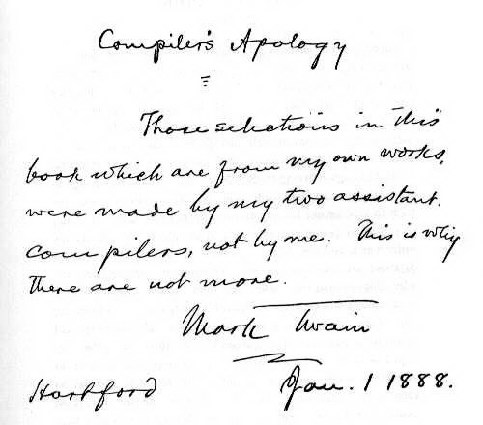
Mark Twain demonstrates.
When is the last time you sent a handwritten note on, you know, paper? Or received one?

The Post Office says that the average home received a personal letter only once every seven weeks in 2010, down from once every two weeks in 1987.

What about in business? Are you relying on email "blasts" to reach your customers? So is everybody else. A recent study indicated the average corporate email account sent or received more than 100 emails per day, and Americans between the ages of 18 and 29 nowsend or receive nearly 100 texts per day. What if you did an end run with a piece of paper?

Author John Coleman notes several things about handwritten communication.
  • Handwritten notes mean more because they cost more. Emails, tweets, texts, or Facebook messages are essentially costless.
  • Electronic communications are rarely notable. But handwritten notes are unusual. They take minutes (or hours) to draft, each word carefully chosen with no "undo" or "autocorrect" to fall back on. Drafting one involves selecting stationery, paying for stamps, and visiting a mailbox. They indicate investment, and that very costliness indicates value. 
  • That conveyance of value is amplified by the fact that personal messages are often notes of gratitude, civility, and appreciation that reach beyond the conventional thank-you. Because handwritten notes are so painstakingly slow — to draft, to send, to assure delivery — they're often a poor way to ask for things. Instead, they're more frequently used to remind others that you value your relationship.
  • Handwritten notes have permanence. How many of us have our old high school yearbooks in a closet somewhere? Email is "permanent" in its own way; our electronic messages are easy to keep and search in huge volumes. But they aren't tangible and enduring in the same way those old notes are. We don't print emails and display them on our desks, refrigerators, and mantles they way we do with letters and notes from friends. The physical notes are more memorable.
It has not escaped me that I wrote this post on a screen and that you are reading it on a screen.

Thursday, February 28, 2013

Stop capitalizing everyhing

I come across unnecessary capitalization in business writing all the time.

Often it involves corporate departments, e.g., Human Resources or Finance Department. Sometimes I see only one word capitalized: Finance department. Sometimes these words refer to a specific company's department; sometimes they refer to departments in general.

Sometimes the capitalization seems completely random: the Client or the Regulation.

Capital letters are speed bumps. They slow the eye as it scans across a sentence. So avoid them wherever possible.

Let's start with departments. Proper names, i.e., names of specific things or people, are capitalized. So I suppose "the GE Department of Human Resources" is technically correct. But is it necessary? Not really. The only time you should capitalize a corporate department is when it refers to a specific company's department, and then you want to get the name exactly correct. I would argue, however, that capitalization in that case isn't necessary for meaning.

Now for titles. When they come before a name, they should be capitalized. So: Chairman of the Board and Chief Executive Office Joe Blow. But do you see how hard that is to swallow. Better: put the title after the name and don't capitalize it. Joe Blow, chairman of the board and chief executive officer. (Notice I left out "of directors" -- the meaning is clear in the context.)

There are some good capitalization tips at EssayInfo, but you'll notice they favor more capitalization than I do.