Showing posts with label thinking. Show all posts

Wednesday, October 29, 2014

Walk, then write

Walking on a Country Road, Valerie Jeanne Frischmann
I  often read through the material I will use to write something for a client and then go for my walk. It's a two-mile trek down a quiet side road, beside which there is a stream for a bit.

The ideas enter the thought scrum in my head and take their lumps. I know my work is better for having walked, although I don't charge for the time. A good bit of the work happens on the road.

Here are some things we know about walking and thinking:
What is it about walking, in particular, that makes it so amenable to thinking and writing? The answer begins with changes to our chemistry. When we go for a walk, the heart pumps faster, circulating more blood and oxygen not just to the muscles but to all the organs—including the brain. Many experiments have shown that after or during exercise, even very mild exertion, people perform better on tests of memory and attention. Walking on a regular basis also promotes new connections between brain cells, staves off the usual withering of brain tissue that comes with age, increases the volume of the hippocampus (a brain region crucial for memory), and elevates levels of molecules that both stimulate the growth of new neurons and transmit messages between them.
Moreover, walking in the country is best.
A small but growing collection of studies suggests that spending time in green spaces—gardens, parks, forests—can rejuvenate the mental resources that man-made environments deplete. Psychologists have learned that attention is a limited resource that continually drains throughout the day. A crowded intersection—rife with pedestrians, cars, and billboards—bats our attention around. In contrast, walking past a pond in a park allows our mind to drift casually from one sensory experience to another, from wrinkling water to rustling reeds.
It's said that William Wordsworth—whose poetry is filled with tramps up mountains, through forests, and along public roads—walked as many as a hundred and eighty thousand miles in his lifetime, which comes to an average of six and a half miles a day starting from age five.

Wonder if he charged.

Thursday, October 2, 2014

Bessie the cow on the ladder of abstraction

Bessie dodges the issue.
Paying attention to the length and complexity of words, as I noted here and here, gives your reader a helping hand in understanding you and, if nothing else, staying awake.

Those posts dealt with the origins of English words, those of Latin derivation being longer and more abstract than those of Germanic origin.

Another way to get at this is a concept known as "the ladder of abstraction," a creation of the American linguist S. I. Hayakawa.

Have you ever experienced writers or speakers who:
  • bury you in an avalanche of data without providing the significance?
  • discuss theories and ideals, completely detached from real-world practicalities?
Each of these is at one end of the ladder. Andrew Dlugan, a speech coach, has a good explanation of the ladder on his website here. He illustrates the idea with Hayakawa's example of a cow named Bessie:
  • wealth (most abstract, top of the ladder)
  • assets
  • farm assets
  • livestock
  • cows
  • the cow named Bessie
  • atoms and molecules forming Bessie (most concrete, bottom of the ladder)
Any of these is appropriate, depending on your context. During a presentation or in a piece of writing you should be moving up and down the ladder, Dlugan says.
Audiences need both concrete details and abstract principles and lessons. To make a persuasive argument and establish a powerful rhythm, balance your speech between the two. Move up and down the ladder (and spend some time in the middle, if appropriate), making your message more understandable for the audience at many different levels.
As you edit and rewrite, ask yourself where each word is on the ladder and decide if that's where you want to be at this point. Are you starting with specifics and then drawing a conclusion from them? Are you starting with a big idea and supporting it with details?

To help you remember to do this, keep the image of Bessie on the ladder in your mind. Go ahead, get it out of your mind. Go ahead.

Tuesday, May 27, 2014

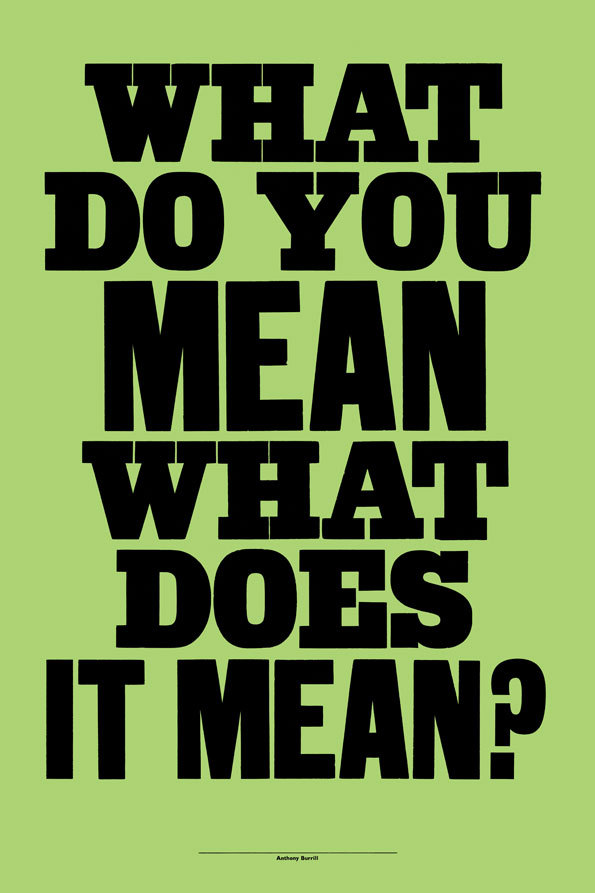
What do you mean?

Writer to editor.
“Writing is an instrument for conveying ideas from one mind to another; your job as a writer is to make the reader grasp your meaning readily and precisely. Do you always say just what you mean? Do you yourself always know just what you mean?”

~ Ernest Gowers

Gowers was the author of Plain Words, which has recently been revised by his daughter, Rebecca Gowers. Michael Skapinker, a Financial Times columnist, calls it "still the best book on English and how to write it."

Before we can transmit meaning to the reader, we must say what we mean. That requires that we know just what we mean.

Writing helps us to discover that. This is why writing is really rewriting. The first go is where we discover what it is we're thinking. The second draft is where we attempt to explain what it is we're thinking. It's where we discover that free floating thoughts don't translate easily to linear words on paper.

A final draft cleans it all up: Is this the wrong word? Will a reader get this?

That's when it's ready for an editor, who will point out that we're kidding ourselves.

Monday, April 14, 2014

Asking the right questions

I keep six honest serving-men
(They taught me all I knew);
Their names are What and Why and When
And How and Where and Who.
~ Rudyard Kipling

Asking these questions has become known as "the Kipling method" after the little ditty in his Just So Stories.

When you are wrestling with the often abstract concepts in business and economics, these are excellent questions to bring you down to earth.

In fact, they've been used for centuries to get at the essence of something. In the 19th Century, Prof. William Cleaver Wilkinson popularized the "Three Ws" – What? Why? What of it? – as a method of Bible study:
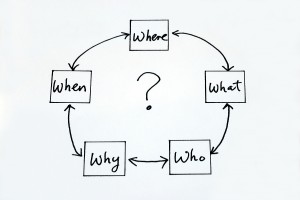
"What? Why? What of it?" is a plan of study of alliterative methods for the teacher emphasized by Professor W.C. Wilkinson not as original with himself but as of venerable authority. "It is, in fact," he says, "an almost immemorial orator's analysis. First the facts, next the proof of the facts, then the consequences of the facts. This analysis has often been expanded into one known as "The Five Ws:" "When? Where? Who? What? Why?" Hereby attention is called, in the study of any lesson: to the date of its incidents; to their place or locality; to the person speaking or spoken to, or to the persons introduced, in the narrative; to the incidents or statements of the text; and, finally, to the applications and uses of the lesson teachings.
How can you use this idea? David Straker offers some good advice. He suggests expanding the basic questions:
One approach with this is to use the questions in a particular order to help guide you through a sequence of thought towards a complete answer, such as:
  • What is the problem?
  • Where is it happening?
  • When is it happening?
  • Why is it happening?
  • How can you overcome this problem?
  • Who do you need to get involved?
  • When will you know you have solved the problem? 
Try it the next time you're wrestling with a difficult concept.

Thursday, March 27, 2014

Answering the right questions

There's a story here.
Reporters are taught to ask the "5 Ws": who, what, where, when, why. It would be tidier if "how" started with a "w," but we're stuck with it.

This series of questions, also used in police work and elsewhere, can be useful to someone writing about business and economics, even the sometimes abstract "thought leadership."

These questions serve several purposes. One, they are the basics of a story. Two, they anchor what we're trying to say in specifics.

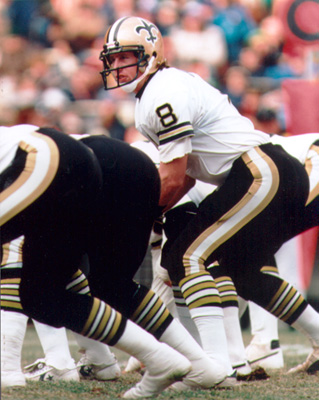
Let me illustrate. I began my career in the New Orleans bureau of The Associated Press. It was our duty to report on home games of the Saints football team. We had a formula for starting these stories. Before I show it, let me suggest several ways to begin a story about a professional football game:
  • The first game of American football, which evolved from rugby football, was played in 1869 between Rutgers and Princeton, two schools in New Jersey.
  • As with other football teams, the New Orleans Saints sent 11 men on to the field to take on 11 men from another team and seek to score more points.
Huh? Now here is how we would write it:
  • NEW ORLEANS -- Archie Manning threw three touchdown passes, including a 57-yarder, to lead the New Orleans Saints to a 43-14 victory over the Dallas Cowboys on Sunday in the Superdome.
That's a story. It's got a hero in it. He overcomes opposition and achieves his goal. We know who, what, where, when and how. The why is unspoken but understood.

Think about your writing. Can you take that clever, abstract, in the clouds idea and create a story using these questions? I guarantee your readers will appreciate the effort.

Thursday, January 16, 2014

What I don't know would fill books

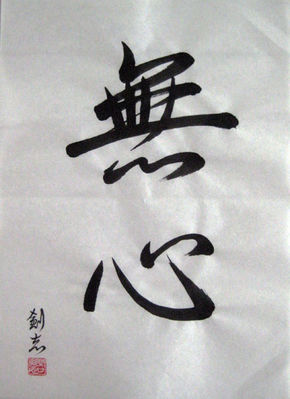
Mushin.
A friend of mine recently told me that learning to say "I don't know" was very hard, especially in the corporate world, where we are expected to fake to make it to 5 o'clock.

When he finally learned to admit it that he didn't know everything, my friend said, he felt, well, enlightened. At least liberated.

I've been reading about Japanese calligraphy, and I'm playing with the idea mastering it is somewhat akin to "I don't know." The masters of this art, or shodō, are said to seek a "no mind state" before they pick up the brush
To write Zen calligraphy with mastery, one must clear one's mind and let the letters flow out of themselves, not practice and make a tremendous effort. This state of mind was called the muslin ("no mind state") by the Japanese philosopher Nishida Kitaro. It is based on the principles of Zen Buddhism, which stresses a connection to the spiritual rather than the physical.
Here is more on mushin.
The term is shortened from mushin no shin, a Zen expression meaning the mind without mind and is also referred to as the state of "no-mindness". That is, a mind not fixed or occupied by thought or emotion and thus open to everything. 
Mushin is achieved when a person's mind is free from thoughts of anger, fear, or ego during combat or everyday life. There is an absence of discursive thought and judgment, so the person is totally free to act and react without hesitation and without disturbance from such thoughts. At this point, a person relies not on what they think should be the next move, but what is felt intuitively.
I hesitate to attempt an application of this concept, especially to the matter of fact world of business writing. That would seem to violate the principle.

However, these thoughts arise, particularly for the business of thought leadership.

1. We all carry around a burden of beliefs and assumptions, and we aren't really aware of them. For example, do you assume that people act rationally? How does this influence your writing? Do you believe that capitalism is best when unfettered? How does this affect what you choose to write about?

2. If we wish to be genuine leaders of thought, we won't get there by repeating everything we think we know. We have to clear our minds of all that. We have to start afresh.

3. If we start from a position of humility -- I know very little -- we are more likely to arrive at a new insight, as opposed to a rearrangement of the thoughts of others. I guess I should be grateful for all I don't know.

Good writing is the fresh expression of a fresh idea. An empty mind seems a good starting point.

Friday, October 18, 2013

To write well, daydream well

Jessica Lahey, an author and former teacher, writes in The Atlantic about the lost art of daydreaming and its value for our children.

She quotes psychologist Scott Barry Kaufman:
The rewards include self- awareness, creative incubation, improvisation and evaluation, memory consolidation, autobiographical planning, goal driven thought, future planning, retrieval of deeply personal memories, reflective consideration of the meaning of events and experiences, simulating the perspective of another person, evaluating the implications of self and others’ emotional reactions, moral reasoning, and reflective compassion.
If it's good for children, why isn't it good for adults? Well, it is.

On a 30-minute walk on my road in the evening I often create an entire 750-word column in my mind. It needs a bit of sharpening, of course, but it's there. It springs forth seemingly out of nowhere. I've always marveled at this, but it should be no surprise. A mind at rest from the daily toil is free to play.

Sigmund Freud makes the connection for us:
Might we not say that every child at play behaves like a creative writer, in that he creates a world of his own, or, rather, rearranges the things of his world in a new way which pleases him? The creative writer does the same as the child at play. He creates a world of phantasy which he takes very seriously — that is, which he invests with large amounts of emotion — while separating it sharply from reality.
Of course, you might want to first close your office door.

Thursday, September 19, 2013

Why we do our best thinking in the shower

Thinks too much.
It's said that Woody Allen will jump in the shower when he needs a mental boost -- several times a day if necessary.

And there's the all-star baseball player David Ortiz: "Even when I'm taking a shower, I work on my swing."

The shower creates the perfect conditions for a creative flash, coaxing out your inner genius, Lucas Reilly writes:

Research shows you’re more likely to have a creative epiphany when you’re doing something monotonous, like fishing, exercising, or showering. Since these routines don’t require much thought, you flip to autopilot. This frees up your unconscious to work on something else. Your mind goes wandering, leaving your brain to quietly play a no-holds-barred game of free association.

This kind of daydreaming relaxes the prefrontal cortex—the brain’s command center for decisions, goals, and behavior. It also switches on the rest of your brain’s “default mode network” (DMN) clearing the pathways that connect different regions of your noggin. With your cortex loosened up and your DMN switched on, you can make new, creative connections that your conscious mind would have dismissed.

Strange as it sounds, your brain is not most active when you’re focused on a task. Rather, research shows it’s more active when you let go of the leash and allow it to wander. Shelley Carson at Harvard found that highly creative people share one amazing trait—they’re easily distracted. And that’s the beauty of a warm shower. It distracts you. It makes you defocus. It lets your brain roam. It activates your DMN and encourages wacky ideas to bounce around.
A a shower is relaxing. It’s a small, safe, enclosed space. You feel comfortable there. On top of that, you’re probably alone. It may be the only alone time you get all day. It’s your chance to get away from any stresses outside.

When you’re that relaxed, your brain may release everyone’s favorite happy-go-lucky neurotransmitter, dopamine. A flush of dopamine can boost your creative juices. More alpha waves will also ripple through your brain—the same waves that appear when you’re meditating or happily spacing out. Alphas accompany your brain’s daydreamy default setting and may encourage the creative fireworks.

The time you shower also plays into the equation. Most of us wash up either in the morning or at night—when we’re most tired. That’s our creative peak. The groggy morning fog weakens your brain’s censors, keeping you from blocking the irrelevant, distracting thoughts that make great ideas possible. It’s likely that your shower gushes during your creative sweet spot.

Thursday, September 5, 2013

It's not what they think; it's what they believe

"It ain't what you don't know that gets you into trouble. 
It's what you know for sure that just ain't so."

~ Mark Twain

Sometimes people refuse to be persuaded. Deeply held beliefs trump argument and evidence. Brian Klapper, a management consultant, tells the story of a company like this.
The CEO of a large U.S. furniture manufacturer asked me to help him reduce customer fulfillment time from 12 weeks to four weeks. The company was using an automated conveyor belt assembly line, and when the workers were unable to keep up with the pace, they hurriedly removed the pieces from the line and put them on the floor — reminiscent of the candy factory scene from "I Love Lucy." Beside each operator was a large pile of partially assembled furniture. 
I suggested to the CEO that unplugging the line and allowing the workers to set the pace would not only result in faster turnaround, but also significantly higher quality furniture, given that the furniture incurred tremendous damage when moved from the belt to the floor. However, management was not convinced. To demonstrate the effectiveness of our suggestion, we set up a pilot line in an abandoned factory, which we ran for a month. Thru-put was 30% higher, quality reached record levels, and morale was way up. Still, management remained unconvinced, believing that workers must be directed, tightly managed, and never allowed to set their own pace.
This is not uncommon. It's a form of confirmation bias. Psychologists Lee Ross and Craig Anderson write:
Beliefs can survive potent logical or empirical challenges. They can survive and even be bolstered by evidence that most uncommitted observers would agree logically demands some weakening of such beliefs. They can even survive the total destruction of their original evidential bases.
For one who wishes to persuade, then, the first task is to understand what the other person believes. Those beliefs will even determine what the person chooses to read. Don't expect a liberal to read a conservative magazine. Don't expect an executive who is skeptical of management consultants to be eagerly anticipating the next issue of McKinsey Quarterly.

In another post I'll explore how we might deal with confirmation bias.

Monday, July 15, 2013

To be creative, distract yourself

Apparently you need to distract your mind if you want it to function effectively.

Some researchers in France, for instance, discovered that people were nearly twice as likely to give the correct response to a complex decision-making problem if they were distracted by a simple three-minute number-matching task before being asked for their answers.
A more-demanding distraction had no such effect: Participants had a 75% chance of giving the right answer after the easy task, but just a 40% chance after a tougher task or if there was no distractor at all. During an easy distraction, the brain seems to unconsciously enhance the memory of a problem's essence, the researchers say.
Then some folks at the University of Illinois at Urbana-Champaign had people brainstorm ideas for new products while they were exposed to varying levels of background noise. Their results found that a level of ambient noise typical of a bustling coffee shop or a television playing in a living room, about 70 decibels, enhanced performance compared with the relative quiet of 50 decibels.
A higher level of noise, however, about 85 decibels, roughly the noise level generated by a blender or a garbage disposal, was too distracting, the researchers found. 
Ravi Mehta, an assistant professor of business administration at the university who led the research, said that extreme quiet tends to sharpen your focus, which can prevent you from thinking in the abstract. 
“This is why if you’re too focused on a problem and you’re not able to solve it,” Dr. Mehta said, “you leave it for some time and then come back to it and you get the solution.”
But moderate levels can distract people just enough so that they think more broadly. “It helps you think outside the box,” he said. 
The benefits of moderate noise, however, apply only to creative tasks. Projects that require paying close attention to detail, like proofreading a paper or doing your taxes, Dr. Mehta said, are performed better in quiet environments.
If you're a writer, and you like and can afford Starbucks coffee, I guess you're in luck. As for myself, I think this argues for working with an NCIS rerun on.

Wednesday, March 20, 2013

So don't believe me

If you wish to persuade others, you must first understand where they are. Do they even know who you are? Do they understand the subject you have an opinion about? Do they speak your language? Do they understand your jargon?

On and on. One important question to ask: what does my listener/reader believe about the topic? You might be able to persuade them with logic, but you'll have a hard time if your viewpoint violates a belief they have or is inconsistent with their everyday knowledge.

This is why people on different sides of the political aisle never get anywhere: each side starts with long-held beliefs that color their perception of arguments. Think about these subjects: climate change, biological evolution, nuclear power, genetically modified crops, exposure to synthetic chemicals, concealed carry of guns, vaccines, video games, fracking, organic foods, and sex education.

It's pretty obvious with these hot button topics that if you or your organization want to persuade people you'll be going up against some strongly held beliefs. But what about more innocuous subjects? What do people think about consultants, automatic subscription renewals, credit cards, borrowing money, charity, customer service, big banks, rebates, and on and on?

This tendency is known as belief bias. This has been studied endlessly. One recent study helps explain the political divide in our country.

Here are three examples:

  1. We tend to believe that a good experience is more enjoyable when it follows a bad experience. Not always so.
  2. We tend to believe that more choice is better. Research proves otherwise.
  3. We believe that new experiences give us more pleasure than things we know. Not always.

You'll run into variations of this. One is "belief perseverance," which occurs when someone clings to a belief despite all the evidence. Another is "confirmation bias," the name for someone finding only evidence that supports his belief.

If nothing else, this might save you from a pointless argument at the dinner table. At best, it may help you craft your next op-ed or speech.