Showing posts with label usage. Show all posts

Wednesday, May 28, 2014

When the glove didn't fit

The power of rhyme.
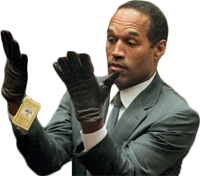
Johnnie Cochran, the defense attorney who got O.J. Simpson acquitted of murder, told the jury:

"Remember these words:
If it doesn't fit, you must acquit."

For emphasis he said, "Remember these words." But that wasn't necessary. Most everyone remembers them to this day.

Rhyme has a special effect on our brains. It's called the "rhyme as reason" effect, or "the Keats Heuristic" after the poet. Various experiments have shown that people judge a saying or aphorism as more accurate or truthful when it rhymes. It also works in advertising and in product names.

Consider:
One if by land, two if by sea. And I on the opposite shore will be.
Hey, hey, L.B.J., how many kids did you kill today?
It takes a licking but keeps on ticking.
When you need an edge, use Pledge.
Lean Cuisine, Reese’s Pieces, Ronald McDonald
The power of rhyme is perhaps why we use it so often with little children. The babies of pregnant women who read "The Cat in the Hat" by Dr. Seuss repeatedly during their last trimester recognized the verse when they were born, distinguishing it from verse that didn't rhyme.

Why is rhyme so pleasurable?
One theory is that humans like anything that purifies the basics of their world and that resonates with the way the brain decodes the blooming, buzzing confusion out there. We like stripes and plaids, we like periodic and harmonic sounds and we like rhymes.
We don't have to work so hard to understand rhyme.
This gives the phrase what psychologists call "fluency." Research in this area tends to point to the fact that messages that are more fluent are not only more memorable, they’re also perceived as being truer. They’re memorable because they are processed more easily. That ease of processing makes them easier to recall. And of course, messages that you can actually remember are much easier to spread to others.
People are more likely to accept a proposition they don't believe if it's presented in rhyme, says Matthew McGlone, Ph.D., a psychologist at Lafayette College in Pennsylvania. Asked whether financial success makes people healthier, almost all of McGlone's subjects disagreed, but "wealth makes health" seemed much more plausible.

Occasionally, rhyme has the opposite effect, however. "It will backfire when an audience has reason to be suspicious of the speaker," McGlone says. "
For instance, Cochran's "if the glove doesn't fit'"line was treated as a rallying cry by African-American newspapers, but as a gimmick by the mainstream press, which for the most part portrayed Cochran as a huckster from the beginning of the trial." Suspicion,  McGlone explains, provides the motivation to scrutinize a message more closely -- and to make sure it's as pleasing to the intellect as it is to the ear.
Cochran was a successful, wealthy and flamboyant lawyer who liked to say that he worked "not only for the OJs, but also the No Js". Another member of Simpson's "Dream Team" of lawyers was Gerald Uelmen, who came up with the glove doesn't fit phrase, which Cochran borrowed.

If you wish to incorporate rhyme in your speaking or writing, remember that Cochran was a showman. It was in character for him to do this. Moreover, the glove was a central part of the case; the rhyme was not manufactured and forced to fit. As it were.

Tuesday, May 13, 2014

Leaving the state of confusion

I live in Ct., and I will forego jokes about whether you can call living in Conn. living. Let's just say it's not much different than living in CT.

This is why I'm pleased with my former employer, The Associated Press, for declaring that, henceforth, states will be spelled out in running text. There are all sorts of qualifiers, but the heck with them.

I've been spelling out state names for a long time, because I've never figured out in which state I live. Or what about those pathetic people in Wisc.? Don't you just hate to type Wisc.? I do. It's just odd.

We can blame all this on the Post Office and its two-letter system. Is it any wonder that monstrosity is running up $25 million a day in debt to add to its $20 billion? It's all due to that two-letter madness.

BTW, the refined and somewhat uppity Chicago Manual of Style has always spelled out state names. Then again, Chicago's pension fund is short about $20 billion, too, although I think I'm in a state of confusion. I'm just so delirious over the The AP's decision.

Friday, March 21, 2014

More than my dead body!

Listen to the cows.
If you weren't worried about the end of civilization before, worry now.

The Associated Press, my employer for eight years back when words meant something, has now decreed that over is a suitable synonym for more than.

Earth to AP: The rest of us know it isn't.

“There are only two forces that can carry light to all the corners of the globe, "Mark Twain wrote, "the sun in the heavens and the Associated Press down here.”

Oh right, Mark.

He also wrote: "The difference between the almost right word and the right word is really a large matter—’tis the difference between the lightning-bug and the lightning."

Do you really want to read that, "New York's population is over Alabama's."? How would they get up there?

Or that  winter is finally more than? Or that the AP's reputation is also more than?

I don't.

A lot of people won't get more than this. As one journalist wrote, "I felt a disturbance in the force."

(Rachel Kirkpatrick)
“There are only two forces that can carry light to all the corners of the globe… the sun in the heavens and the Associated Press down here.” - See more at: http://www.vocus.com/invocus/media-blog/mark-twains-ap-no-more/#sthash.YUPKKiTN.dpuf

Wednesday, March 12, 2014

Is it shall or will?

The bottom line: use will for everything, and you'll be safe from the grammar police.

If, however, you want to emphasize your intention, use shall. A famous example of this is in John Kennedy's inaugural address:
Let every nation know, whether it wishes us well or ill, that we shall pay any price, bear any burden ...
There are some other rules -- if you happen to live upstairs at Downton Abbey or plan to meet the queen.

Here's how they say it:
In British English, there has been a traditional rule that shall is to be used when the subject is in the first person (I or we), and will in other cases. In practice this rule is commonly not adhered to by any group of English speakers, and many speakers do not differentiate between will and shall when expressing futurity, with the use of will being much more common and less formal than shall. In many specific contexts, however, a distinction still continues.
So it's a rule, but not a rule. Got it? Fowler allows as how the rule "is so complicated that those who are not to the manner born can hardly acquire it."

Winston Churchill surely knew the rule. I don't know if he was honoring it when he promised:
"We shall go on to the end. We shall fight in France, we shall fight on the seas and oceans, we shall fight with growing confidence and growing strength in the air, we shall defend our island, whatever the cost may be. We shall fight on the beaches, we shall fight on the landing grounds, we shall fight in the fields and in the streets, we shall fight in the hills; we shall never surrender ... "
His use of shall with the first person we is proper. An American, however, hears an emphasis. I suspect he did as well. As it should be.

Friday, January 24, 2014

Short words are the best

They were the first words. Use them.

A writer at The Economist:
Though the tongue in which you read this stole words from here and there, and still does, at the start, if there was one, its words were short. Huh, you may say, those first “words” were no more than grunts.
Yet soon they grew to be grunts with a gist, and time has shown that, add to the length of your words as you may, it is hard to beat a good grunt with a good gist. That is why the short words, when old, are still the tops. Tough as boots or soft as silk, sharp as steel or blunt as toast, there are old, short words to fit each need.
You want to make love, have a chat, ask the way, thank your stars, curse your luck or swear, scold and rail? Just pluck an old, short word at will. If you doubt that you will find the one you seek, look at what can be done with not much: “To be or not to be?” “And God said, Let there be light; and there was light,” “We are such stuff as dreams are made on.”

“Short words are best,” Winston Churchill said, “and old words when short are the best of all.”

Thursday, January 23, 2014

You don't need to use "utilize"

Editors assume that writers use utilize in an effort to sound important. That's why most editors will compulsively change it.

For one thing, it has three syllables with a "t" and a "z" in there to slow the reader up.

It is not synonymous with use.

Editors talking about you.
We know how to use use, and you can go right ahead and use it whenever you like, and you won't be wrong.

Utilize, however, has a more specific meaning: You utilize items when you create a new or nontraditional job for them. For example:
You can use a fork to eat with, or you can use a fork to prop open a window, without stepping into any grammar holes. However, you can not utilize a fork for eating, while you can utilize a fork to prop open a window.
Got it? Here's more:
Merriam-Webster defines utilize as, “to make use of; turn to practical use or account.” So how is this different from use? In a nutshell, to utilize something is to give it a use it may not have originally had. For example:

• Yes, you can utilize the conference room for your holiday party.
• We utilize Excel for our database instead of Access.
• Our company utilizes many common tools to come up with new innovations.
That's enough. My suggestion is that, unless you're trying to make a specific point about the use of an item, don't use utilize lest people think you're pretentious.

Tuesday, October 15, 2013

Actually, you really don't need adverbs. Really.

Just say no.
In all matters language I defer to my patron saint, Mark Twain, and on adverbs his pronouncement is:
"I am dead to adverbs; they cannot excite me. To misplace an adverb is a thing which I am able to do with frozen indifference. Yes, there are things which we cannot learn, and there is no use in fretting about it. I cannot learn adverbs; and what is more I won't."
Stephen King is a good writer, and in his opinion:
"I believe the road to hell is paved with adverbs, and I will shout it from the rooftops. To put it another way, they're like dandelions. If you have one on your lawn, it looks pretty and unique. If you fail to root it out, however, you find five the next day . . . fifty the day after that . . . and then, my brothers and sisters, your lawn is totally, completely, and profligately covered with dandelions. By then you see them for the weeds they really are, but by then it's--GASP!!--too late."
So there.

I recently came across Pat Holt's blog. She's a longtime book editor. Adverbs are on her list of ten mistakes.
Actually, totally, absolutely, completely, continually, constantly, continuously, literally, really, unfortunately, ironically, incredibly, hopefully, finally – these and others are words that promise emphasis, but too often they do the reverse. They suck the meaning out of every sentence. 
I defer to People Magazine for larding its articles with empty adverbs. A recent issue refers to an “incredibly popular, groundbreakingly racy sitcom.” That’s tough to say even when your lips aren’t moving. 
In Still Life with Crows, Douglas Preston and Lincoln Child describe a mysterious row of corn in the middle of a field: “It was, in fact, the only row that actually opened onto the creek.” Here are two attempts at emphasis (“in fact,” “actually”), but they just junk up the sentence. Remove them both and the word “only” carries the burden of the sentence with efficiency and precision. 
(When in doubt, try this mantra: Precise and spare; precise and spare; precise and spare.)
In dialogue, empty adverbs may sound appropriate, even authentic, but that’s because they’ve crept into American conversation in a trendy way. If you’re not watchful, they’ll make your characters sound wordy, infantile and dated. 
In Julia Glass’s Three Junes, a character named Stavros is a forthright and matter-of-fact guy who talks to his lover without pretense or affectation. But when he mentions an offbeat tourist souvenir, he says, “It’s absolutely wild. I love it.” Now he sounds fey, spoiled, superficial.. (Granted, “wild” nearly does him in; but “absolutely” is the killer.)
The word “actually” seems to emerge most frequently, I find. 
Ann Packer’s narrator recalls running in the rain with her boyfriend, “his hand clasping mine as if he could actually make me go fast.” Delete “actually” and the sentence is more powerful without it. 
The same holds true when the protagonist named Miles hears some information inEmpire Falls by Richard Russo. “Actually, Miles had no doubt of it,” we’re told. Well, if he had no doubt, remove “actually” – it’s cleaner, clearer that way. “Actually” mushes up sentence after sentence; it gets in the way every time. I now think it should *never* be used. 
Another problem with empty adverbs: You can’t just stick them at the beginning of a sentence to introduce a general idea or wishful thinking, as in “Hopefully, the clock will run out.” Adverbs have to modify a verb or other adverb, and in this sentence, “run out” ain’t it. 
Look at this hilarious clunker from The Da Vinci Code by Dan Brown: “Almost inconceivably, the gun into which she was now staring was clutched in the pale hand of an enormous albino.” 
Ack, “almost inconceivably” – that’s like being a little bit infertile! Hopefully, that “enormous albino” will ironically go back to actually flogging himself while incredibly saying his prayers continually.
Hopefully, you'll constantly remember this.

Friday, October 4, 2013

How "different from" is different from "different than"

Different from New York.
I suppose it's a rather minor matter in the world of writing. Whether to use "different from" or "different than" is different from more serious issues, such as getting your subject to agree with you verb.

However, to people who do this stuff for a living it does matter. You can find a lively discussion in a Linked In group called LinkEds & Writers. It's not for the faint of heart, and you may well have to join the group to see what editorial sausage making looks like, which is a blessing.

I googled around and found an explanation I like at a University of Houston - Victoria website. Here's the thing: you're not going to jail if you don't follow the rules here. But it's good to know. You can, for instance, amaze a total stranger at a cocktail party with your newfound knowledge.

David Felts writes:

What is the difference?
In the 18th century, different than began to be seen as unacceptable in certain situations. This view has survived for the most part. Many grammar books, such as Strunk and White’s The Elements of Style, argue against using different than. Different from is preferred and considered correct, but different than is considered acceptable on some occasions.

When to use different from
Use different from for simple comparisons, as in comparing two persons or things.
Ex.: My car is different from (not than) her car.
Ex.: The book I bought is different from the one sold in the bookstore.
It is important to remember that when using different from, the two things being compared (e.g. my car and her car in the first example) should have the same grammatical structure. This is called parallel construction. Here are a couple of examples:
Ex.: People in the field of literature write differently from people in the field of business.
Ex.: People in the field of literature write differently from those in the field of business.
When different than is acceptable
Because of increased use, different than is sometimes considered acceptable in American English. When in doubt, just use different from, as it is preferred by most people. According to the American Heritage Dictionary’s usage panel (1992), different than is acceptable only if the words following different than make up a clause—especially if the clause is elliptical (referring to an aforementioned context without restating it). Here’s an example:
Ex.: It seems so different than Paris.
In this example, if different from were used, Paris, the city, would be the object of comparison. Using different than creates a subtle distinction in meaning. Since different than is used, the clause following different than is interpreted as elliptical and suggests “the way things were in Paris” or "than Paris was" or “what happened in Paris.” If you have doubt when to use different than, you might just use different from following the parallel construction rule.

So there you are. Thanks, David. I wonder if he's ever been to Paris. I haven't.

Wednesday, August 14, 2013

Do you infer what I'm implying?

Infer this.
In an episode of Law & Order SVU, two cops have an exchange with a suspect:
Cop: What'd he do aside from keeping the victim from the cameras, thereby saving your five-star ass?
Suspect: He gave us no choice. He hasn't shown up for work since the event.
Cop: How convenient. The only employee that can testify in court.
Suspect: What you're inferring is preposterous.
Cop: Implying.
Other cop: You did infer what he implied.
Cop: But on the bright side, you did infer correctly.
By now the suspect should be ready to confess.

Here's the rule on these two words: Imply and infer are opposites, like a throw and a catch. To imply is to hint at something, but to infer is to make an educated guess. The speaker does the implying, and the listener does the inferring.

You'll just have to memorize them.

Imply comes from the Latin implicāre, meaning to implicate. Infer comes from the Latin inferre, which means to bring into.

So you can study Latin, or, as I suggested, just memorize them.

Some unruly types imply that infer can be used to mean imply, but don't infer anything: when we catch them, they're going to the slammer. Don't even think about it.

Friday, June 7, 2013

Write well, get ahead

It's been said many times: how you speak and write affects your success at work. 

The fact that you can use a calculator doesn't mean you know accounting. The fact that you've been writing all your life doesn't mean you do it well. Trust me: I write for a living, and I measure the time in decades, yet I can make some awful mistakes.

Bryan Garner, who has written several books on writing, enters the fray. People see your language as a reflection of your competence, he writes.
Make lots of mistakes in your e-mails, reports, and other documents, and you'll come across as uneducated and uninformed. Others will hesitate to trust your recommendation to launch a resource-intensive project, for example, or to buy goods or services. They'll think you don't know what you're talking about.
He gets right into one of the most common mistakes -- one whose frequency surprises me.
Certain errors will predictably get you in trouble: "Just keep this matter between you and I," for instance, and "Tom and her will run the meeting."
Write instead: "Just keep this matter between you and me." And: "She and Tom will run the meeting." 
The rule, very simply, is that I, we, he, she, and they are subjects of clauses — as in "Leslie and Iwere delighted to work with you." Me, us, him, her, and them are objects of either verbs or prepositions: "You might want to consult with Leslie and me." In the compound phrasings, try leaving out Leslie and — and you'll know the correct form immediately.
He has other examples, but let me suggest that if you can master the I/me challenge, you'll be making the world a better place. And I will give you the afternoon off.

Wednesday, May 22, 2013

Dealing with those troublesome words

There are two kinds of people in this world: those who merrily go their way using/misusing the words below, and those like me for whom a red flag pops up but can't remember the rule.

So to comfort the afflicted and afflict the comfortable, here we go, courtesy of The Editor"s Blog:

First, two words that aren't words:
All right/alright
Alright is not a word. The phrase all right is always two words. You may use a phrase such as, “Awright! I aced my finals” in dialogue if your character pronounces the word as awright. But never, not even in dialogue, use alright. 
A lot/alot
Alot is not a word. When you want to say there are many of some thing, use a lot, two words. We need a lot of sugar to sweeten this mess.
Allot, with two LLs, means to parcel out or allocate. The settlers on Avalon 5 were allotted one horse and two dozen grain bags.
Now for some words we come across everyday, or, rather, every day, or maybe just continually, or, rather, continuously:
Every day/everyday
When every modifies day, it’s a determiner—it qualifies the noun day. It answers the question, how often. He checks his tire pressure every day.Each can be substituted for every and the meaning would be the same. 
The single word everyday is an adjective that modifies a noun. Everyday means daily or ordinary. A fantastic sunrise is an everyday event in Hawaii. 
He gets up everyday is incorrect. He gets up every [each] day is correct.
Continual/continuous
The lines are becoming blurred by usage, but there is a difference between continual and continuous. Use continual for something constantly or frequently occurring. The continual road repairs took a toll on the city’s commuters. Use continuous for something happening without interruption. The continuous drip from the bathroom faucet kept Marie tossing and turning all night.
Do you feel a headache coming on?

Friday, May 17, 2013

Parallel construction does wonders for your writing

Here's a quick cleanup for your writing: parallel construction. Also known as parallelism, it refers to grouping similar ideas with similar phrases or clauses that have the same grammatical structure.

Parallelism improves readability by making sentences easier to process. The likeness of form enables the reader to recognize more readily the likeness of content and function. Parallelism also adds power and elegance to language. Think of the Beatitudes and the Gettysburg address. It's also a good way to reduce the number of words.

Let's look first at parallelism in a sentence.
Faulty Parallelism: Formerly, science was taught by the textbook method, while now the laboratory method is employed. 
Corrected Version: Formerly, science was taught by the textbook method; now it is taught by the laboratory method.
By this principle, an article or a preposition applying to all the members of a series must either be used only before the first term or else be repeated before each term.
Faulty Parallelism: The French, the Italians, Spanish, and Portuguese 
Corrected Version: The French, the Italians, the Spanish, and the Portuguese
Parallelism is also important in lists. If you're going to force a PowerPoint slide on people, at least make the bullet points parallel.
POOR: 
This article will discuss:
  • How to deal with corporate politics.
  • Coping with stressful situations.
  • What the role of the manager should be in the community.
BETTER: 
This article will discuss:
  • Ways to deal with corporate politics.
  • Techniques of coping with stressful situations.
  • The role of the manager in the community.
OR: 
This article will tell managers how to:
  • Deal with corporate politics.
  • Cope with stressful situations.
  • Function in the community.
I actually get paid real money by smart people to fix their non-parallel sentences and lists.

Sunday, April 28, 2013

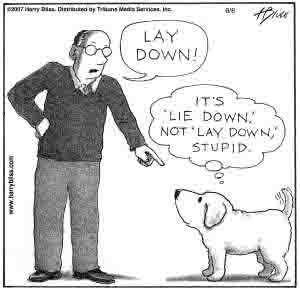
People lie down, chickens lay eggs

Oh boy, we can blame this one on rock and roll. You know it's wrecked an entire generation. Today let's beat up on Eric Clapton and Bob Dylan.

Let's start with Eric. His song "Lay Down Sally" can actually help you remember the difference between lay and lie, Grammar Girl asserts, because he's wrong.

To say “lay down Sally,” she explains, would imply that someone should grab Sally and lay her down. If he wanted Sally to rest in his arms on her own, the correct line would be “lie down Sally.”

I don't know Sally, but I'm going to suggest that for a generation that went into the Sixties and never fully emerged using an incorrect example might be confusing. Just saying.

Next up, Bob. If you can remember "Lay Lady Lay" you should also try to remember that it, too, is wrong. Of course the Sixties generation has trouble remembering yesterday. The lyrics, Grammar Girl says, should be “Lie lady lie, lie across my big brass bed.” Of course, that sounds like you want her to utter an untruth. Maybe you do.

Ben Yagoda has proved that people are screwing this up.

That's called a "Google fight." I'd never heard of that. Had you? Here's where you do that.

Okay, so let's get back to lie and lay. You're just gonna have to memorize it.

Thursday, April 18, 2013

Here's a quick improve for your writing

When I was a cub reporter on the night shift at The AP in New Orleans I'd show up and find notes from my editor about my work the night before.

One evening the note said, "Is 'host' a verb?"

Well, as Hillary said, what does it really matter?

Actually, it's a noun and a verb. But the question was legitimate. One way we can clean up our language -- and make ourselves more easily understood -- is to stop using verbs as nouns. For one thing, it just sounds stupid.
“Do you have a solve for this problem?” “Let’s all focus on the build.” “That’s the take-away from today’s seminar.” Or, to quote a song that was recently a No. 1 hit in Britain, “Would you let me see beneath your beautiful?”
See what I mean?

Henry Hitchings nails it:
If you find these sentences annoying, you are not alone. Each contains an example of nominalization: a word we are used to encountering as a verb or adjective that has been transmuted into a noun. Many of us dislike reading or hearing clusters of such nouns, and associate them with legalese, bureaucracy, corporate jive, advertising or the more hollow kinds of academic prose. Writing packed with nominalizations is commonly regarded as slovenly, obfuscatory, pretentious or merely ugly.
He speculates on why we do this:
Why say “solve” rather than “solution”? One answer is that it gives an impression of freshness, by avoiding an everyday word. To some, “I have a solve” will sound jauntier and more pragmatic than “I have a solution.” It’s also more concise and less obviously Latinate (though the root of “solve” is the Latin solvere).
Well, read his very fine article and just don't do it. And enjoy this:

Monday, March 11, 2013

Write like you know what you're doing

Correctly using like and as will let your discerning readers or listeners know that you know. It will also make your message clearer.

Good instruction in this can be found in The New York Times' blog on the language, After Deadline. Philip Corbett writes:
The word like plays many grammatical roles. The one that raises a usage issue is its sense as a preposition meaning similar to. In that guise it can introduce only a noun or a pronoun: He deals cards like a riverboat gambler. If in doubt about the fitness of a construction with like, mentally test a substitute preposition (with, for example): He deals cards with a riverboat gambler. If the resulting sentence is coherent, like is properly used. 
But when like is used to introduce a full clause — consisting of subject and verb — it stops being a preposition and becomes a conjunction. Traditional usage, preferred by The Times, does not accept that construction:He is competitive, like his father was. Make it as his father was, or simply like his father. If the as construction (although correct) sounds stiff or awkward, try the wayinstead: He is competitive, the way his father was. 
In other cases, if like fails the preposition test, as if may be needed: She pedaled as if [not like] her life depended on it. 
When like is used correctly as a preposition, it faces another test. The items linked by like must be parallel, and therefore comparable. Do not write Like Houston, August in New York is humid. That sentence compares August to Houston, not what its author meant. Make it Like Houston, New York is humid in August.
Like, you know?

Friday, January 4, 2013

Death to all adjectives!

"As to the Adjective; when in doubt, strike it out."

-- Mark Twain

I recently encountered this sentence in a client's draft of a white paper:
Inconsistent, often contradictory demands for detail are so widespread, costly and predictable ...
The sentence is only half over and we have five adjectives describing "demands for detail." Each adjective is an idea in itself, a concept that requires some thinking.

There is a no way a reader can handle that many ideas in the short span of time it takes to read the sentence. So the reader will just rush by, recording this group of words in his brain as mush.

Elsewhere in the paper we get:
... a low risk, high payback ...
This is just two adjectives, of course, but they are made memorable by the contrast of "low" and "high," even though what is low and what is high are different in kind. Moreover, we easily get the whole idea of taking little risk for a big payoff. The only verbal risk here is that this is something of a cliche.

Further on we encounter:
... strategic and operational consistency ...
This is not as powerful as "high" and "low," but it is acceptable, because it delineates two contrasting realms. In business we understand those realms to be different, and this phrase suggests one thing works in both. Catchy.

I'm reminded of Yossarian in Catch 22, who was given the task of censoring the letters of enlisted me. Joseph Heller writes:
To break the monotony he invented games. Death to all modifiers, he declared one day, and out of every letter that passed through his hands went every adverb and every adjective. The next day he made war on articles. He reached a much higher plane of creativity the following day when he blacked out everything in the letters buta, an and the.
Yossarian would make a great editor.

Tuesday, January 1, 2013

If the glove doesn't fit ...

Words matter.
You remember the rest of it ... you must acquit. You remember it because it rhymes.

There is actually a cognitive bias for this phenomenon, the "rhyme as reason" effect. A cognitive bias is a pattern of deviation in judgment that occurs in particular situations, which may sometimes lead to perceptual distortion, inaccurate judgment, illogical interpretation, or what is broadly called irrationality.

Is O.J. running free today because of this bias?

Wikipedia explains the effect.
In experiments, subjects judged variations of sayings which did and did not rhyme, and tended to evaluate those that rhymed as more truthful (controlled for meaning). For example, the statement "What sobriety conceals, alcohol reveals" was judged to be more accurate than by different participants who saw "What sobriety conceals, alcohol unmasks". 
The effect could be caused by the Keats heuristic, according to which a statement's truth is evaluated according to aesthetic qualities; or the fluency heuristic, according to which things could be preferred due their ease of cognitive processing.
You would, of course, use rhyming rarely. You should liberally obey the fluency heuristic: A fluency heuristic in psychology is a mental heuristic where, if one out of two objects is processed more fluently, faster, or more smoothly, the mind infers that this object has the higher value with respect to the question being considered.

Thursday, October 11, 2012

A post which you should read

E.B. White, spinning in his grave.
The title of this post is incorrect, in my opinion. The word which, according to the rule I follow, should only be used with nonrestrictive relative clauses, i.e., clauses that impart a mere extra bit of information.

For restrictive clauses -- those with a crucial bit of definition -- the preferred word is that.

Robert Lane Green, an international correspondent for The Economist, is a descriptivist in matters of the language and so he thinks the title of this post is just swell.
To pick on Strunk and White, they prescribe a rule on “which” and “that” to introduce relative clauses: “which” must introduce a “nonrestrictive” relative clause (a mere extra bit of information). Only “that” can introduce a “restrictive” clause (a crucial bit of definition). You agree with White that “The lawn mower which is broken is in the garage” should have “that,” not “which.” However, even White doesn’t agree with White. As the linguist Geoff Pullum noticed, White used “which” in the “wrong” way in his essay “Death of a Pig”: “the premature expiration of a pig is, I soon discovered, a departure which the community marks solemnly on its calendar.” White would probably say he slipped. I’d console him; no, he didn’t. It’s a fine sentence from a fine American writer.
Green is a frequent contributor to The Economist's excellent blog on writing, Johnson, but, heavens man, are you going to take on Strunk and White and risk a lightning strike?

Furthermore, in the afterlife you'll have to deal with Miss Schindler, who taught me grammar in the eighth grade and who taught my father before me and who would have given me a resounding slap on the shoulder had I confused which and that.

Which I didn't.

Friday, September 14, 2012

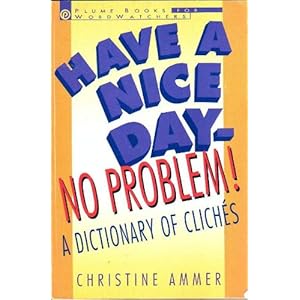
I have issues with that ... no problem!


"In his Studies in Words, C.S. Lewis remarks on our 'responsibility to the language,' and adds that 'it is unnecessary defeatism to believe that we can do nothing' about language change. Lewis affirms that 'language which can with the greatest ease make the finest and most numerous distinctions of meaning is the best.' The question for Lewis is always does a new word add to the richness of the language or does it diminish it. He also cautions his readers to be on the qui vive for words that suggest 'a promise to pay which is never going to be kept,' which applies to three-quarters of the language of psychology and fully half that of contemporary social science.

"Inspired by Lewis, I am for putting a 20-year moratorium on the use of the inflationary word icon to describe anything other than a small religious painting. Nothing to be done about it, I realize, but it is worth noting that the perhaps perfunctory phrase 'You are welcome' has now been replaced with 'No problem,' which does not seem a notable advance in elegance or manners. I'm for banishing the word workshop—which is also available as a verb—to describe what is little more than a classroom discussion of undergraduate poems or stories; 'workshop' used in this sense, Kingsley Amis once remarked, implies all that has gone wrong with the world since World War II.

"Allowing the word issue to stand in for problem—'I have issues with that—is as pure a case of verbicide as I know: a useful word, issue, distinctly different in meaning from problem, describing a matter still in the flux of controversy in a way that no other word does.Impact and focus deserve a long rest from overuse, and process is surely one of those words that never keeps its promise. Perhaps, too, the time has come to call a halt to people describing people as 'highly literate,' given that literate means no more than that one can read and write; what they really mean, presumably, when they say literate is 'literary' or possibly "cultivated," which is not at all near the same thing. 

"Or consider the word disinterested, with its core meaning of impartiality or above personal interest, which has now all but melted into the condition of a pathetic synonym for uninterested. If we lose disinterested do we not also lose the grand ideal that it represents? I fear we may already have done so, at least insofar as I find it impossible at present to name a single disinterested figure on the stage of world politics. Ideas Have Consequences is the title of a once famous book, but words, being the substance out of which ideas are composed, turn out to have even greater consequences."

Tuesday, August 21, 2012

Aks your relator if the house is perty

Metathetically speaking.
When you speak that way you are engaging in metathesis (mê--thê-sis), the switching of one sound or letter in a word with another.

Linguistic metathesis most often involves R and L, the "liquid" consonants: flimsy was created from filmsy by metathesis, linguist Robert Beard writes.
When we say perogative forprerogative or perscription for prescription, we commit metathesis, switching the positions of the R and E. In some dialects of English ask is metathesized to aks and another common speech error is the pronunciation of foliage as foilage, switching the L and the I. Southerners love metathesis: their pronunciations of pretty as perty, and difference [di-frêns] as differnce all reflect this proclivity.
In use: We have our choice of metathetic or metathetical for the adjective, and -ly may be added to the latter for the adverb:metathetically. The verb is a predictable metathesize, as two sounds might metathesize in a word.
History: Metathesis is a Late Latin noun based on the Greek verb metatithenai "to transpose". This verb consists of meta "beyond, over" + tithenai "to place". Meta comes from the same source as English mid and middle. Apparently, it originally meant "between", for that is the meaning of Russian mezhdu, which comes from the same word. Tithenai comes from an earlier form dhe-ti-, the source of English deed and do.