Showing posts with label rules for writing. Show all posts

Tuesday, July 22, 2014

To create, don't break the chain

“Inspiration is for amateurs; the rest of us just show up and get to work.” 
~ Chuck Close, American painter and photographer

If you want to write, you have to write. There's no getting around it.

This is true of any creative endeavor. The Russian composer Pyotr Ilyich Tchaikovsky wrote in 1878:
We must always work, and a self-respecting artist must not fold his hands on the pretext that he is not in the mood. If we wait for the mood, without endeavouring to meet it half-way, we easily become indolent and apathetic. We must be patient, and believe that inspiration will come to those who can master their disinclination. 
A few days ago I told you I was working every day without any real inspiration. Had I given way to my disinclination, undoubtedly I should have drifted into a long period of idleness. But my patience and faith did not fail me, and to-day I felt that inexplicable glow of inspiration of which I told you; thanks to which I know beforehand that whatever I write today will have power to make an impression, and to touch the hearts of those who hear it.
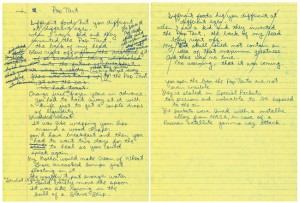
Jerry's Pop Tart joke.
If you won' take it from him, take it from Jerry Seinfeld. When he was starting out he realized that success meant good jokes, and good jokes meant writing good jokes.

So he got a big wall calendar with a whole year on one page and hung it in a prominent place. He also got a big red marker.

On each day that he wrote he put a big red X.
"After a few days you'll have a chain. Just keep at it and the chain will grow longer every day. You'll like seeing that chain, especially when you get a few weeks under your belt. Your only job next is to not break the chain."
Here's Seinfeld on writing a joke about Pop Tarts. It's work, not inspiration.

<iframe width="460" height="315" src="//www.youtube.com/embed/itWxXyCfW5s" frameborder="0" allowfullscreen></iframe>

Tuesday, July 15, 2014

The CIA's rules for writing

Don't tell anyone, but it has them. You didn't hear it from me.

A freedom of information request brought them in out of the cold. Here's what the spymasters think their underlings should know.

All writers using the agency's style guide, it says, "are assumed already to possess the three essentials of intelligence analysis: knowledge, clarity of thought, and good judgment. No writing, however skilled, can conceal deficiencies in these requisites.”

Hmm. I don't think it's just spies.

See if these rules are helpful for you:
  • Keep the language crisp and pungent; prefer the forthright to the pompous and ornate.
  • Do not stray from the subject; omit the extraneous, no matter how brilliant it may seem or even be.
  • Favor the active voice and shun streams of polysyllables and prepositional phrases.
  • Be frugal in the use of adjectives and adverbs; let nouns and verbs show their own power.
  • Be objective; write as a reporter or analyst or administrator unless you are entitled to write as a policymaker.
This is a commandment for any business writer.
For the most part, Directorate of Intelligence analysts are writing for generalists. Generalists may have deep expertise in specific areas, such as missile technology or a country’s tribal politics; nonetheless, the analyst’s goal is to do away with the specialist’s jargon and to put everything into layman’s language. If your audience consists of just a few people who thoroughly understand the subject (or who cannot be trusted to follow the reasoning without jargon to guide them), by all means sprinkle your piece with technical terms. Most of the time, however, write for the nonexpert.
I'm glad this secret leaked.

Monday, July 7, 2014

Zadie Smith's rules for writing

Zadie Smith is a British novelist, essayist and short story writer. She has published four novels, all of which have received substantial critical praise. In 2003, she was included on Granta's list of 20 best young authors, and was also included in the 2013 list. She joined New York University's Creative Writing Program as a tenured professor on September 1, 2010.
Here are her rules for writing:
  1. When still a child, make sure you read a lot of books. Spend more time doing this than anything else.
  2. When an adult, try to read your own work as a stranger would read it, or even better, as an enemy would.
  3. Don’t romanticise your ‘vocation’. You can either write good sentences or you can’t. There is no ‘writer’s lifestyle’. All that matters is what you leave on the page.
  4. Avoid your weaknesses. But do this without telling yourself that the things you can’t do aren’t worth doing. Don’t mask self-doubt with contempt.
  5. Leave a decent space of time between writing something and editing it.
  6. Avoid cliques, gangs, groups. The presence of a crowd won’t make your writing any better than it is.
  7. Work on a computer that is disconnected from the ­internet.
  8. Protect the time and space in which you write. Keep everybody away from it, even the people who are most important to you.
  9. Don’t confuse honours with achievement.
  10. Tell the truth through whichever veil comes to hand — but tell it. Resign yourself to the lifelong sadness that comes from never ­being satisfied.
I particularly like the practicality of 1, 2, and 5. These are sturdy rules you learn either from experience or from an accomplished writer like Smith.

Monday, November 18, 2013

What we can learn from Ernest Hemingway

Hemingway, 1916.
The great novelist, also a writer of nonfiction, began his career as a reporter at the Kansas City Star, where he followed the newspaper's 110 rules for writing.

``Those were the best rules I ever learned for the business of writing,'' Hemingway said in 1940. ``I've never forgotten them. No man with any talent, who feels and writes truly about the thing he is trying to say, can fail to write well if he abides with them.''

Here is a selection of these timeless rules:
Use short sentences. Use short first paragraphs. Use vigorous English. Be positive, not
negative.

Never use old slang. Such words as stunt, cut out, got his goat, come across, sit up and
take notice, put one over, have no place after their use becomes common. Slang to be
enjoyable must be fresh.

Watch you sequence of tenses. “He said he knew the truth, not “He said he knows the
truth.” “The community was amazed to hear that Charles Wakefield was a thief,” not was
amazed to hear that Charles Wakefield is a thief.”

Eliminate every superfluous word as “Funeral services will be at 2 o’clock Tuesday,” not
“The funeral services will be held at the hour of 2 o’clock on Tuesday.” He said is better
than he said in the course of conversation.

Be careful of the word “only.” “He only had $10,” means he alone was the possessor of
such wealth.” “He had only $10,” means the ten was all the cash he possessed.

Avoid the use of adjectives, especially such extravagant ones as splendid, gorgeous,
grand, magnificent, etc.
Here are several I'm a stickler about:
A long quotation with out introducing the speaker makes a poor lead especially and is
bad at any time. Break into the quotation as soon as you can. thus: “I should prefer,” the
speaker said, “to let the reader know who I am as soon as possible.”

“He saw more than one thousand ducks flying” – not “over one thousand ducks.” Also
say “fewer than” instead of “less than,” when numbers, not quantity, are considered. It is
proper to write “He had more than $10.”
``Hemingway was a big, brutal son-of-a-bitch,'' recalled Emmet Crozier, the playwright who was on The Star's sports staff at the time. Hemingway dogged Moise's steps, listening to his theories about tying paragraphs together so they couldn't be cut; that pure objective writing is the only form of story telling; and lamenting ``the regrettable indication of a great nation's literary taste when it chooses a national anthem beginning with the words, `Oh, say.' ''

Tuesday, October 22, 2013

If you can't write, pick up the phone

Galbraith: Pick up the phone.
Here's a tactic that will get you going if you're in a rut and at the same time make your writing stronger.

Pick up the phone.

As a business writer at The Associated Press back in the Dark Ages, I found myself working on a series of articles about coffee prices with a fellow reporter who came up to New York from Washington, where he covered the CIA and other spooky things.

We were going to prove that there was a conspiracy to raise coffee prices. After several weeks of tramping around odd parts of Manhattan chasing down coffee brewers, who wouldn't tell us anything, my colleague allowed as how covering the top-secret CIA was a lot easier.

I digress. I was sitting at my typewriter one morning (I told you it was the Dark Ages) stuck on what to type next. My editor wandered by, took one glance, sized me up, and scolded, "You just can't pick up the phone, can you?"

His point: if you don't know where to go next, get some more information. If you can't write, report.

You can't write your way around a problem. You have to read more or ask someone to get around it. The payoff is that the more facts and data you get, the better your insight into the topic and the more precise and concrete your writing. Specific is always better than general. Real is better than theoretical.

I was reminded of this when I came across an article written in 1978 -- about the same time I discovered that coffee prices go up because of market forces, duh -- by the economist  John Kenneth Galbraith. He had been asked to teach college students about writing, and he was pondering what he might say.

Here's his version of "pick up the phone":
George Bernard Shaw once said that as he grew older, he became less and less interested in theory, more and more interested in information. The temptation in writing is just the reverse. Nothing is so hard to come by as a new and interesting fact. Nothing is so easy on the feet as a generalization. I now pick up magazines and leaf through them looking for articles that are rich with facts; I do not care much what they are. Richly evocative and deeply percipient theory I avoid. It leaves me cold unless I am the author of it. My advice to all young writers is to stick to research and reporting with only a minimum of interpretation. And especially this is my advice to all older writers, particularly to columnists. As the feet give out, they seek to have the mind take their place.
It's good advice for young and old.

Monday, October 7, 2013

The original Mad Man's rules for writing

David Ogilvy, an advertising executive who died in 1999, has been called "the father of advertising" and "the most sought-after wizard in today's advertising industry."

He worked at a time when good writing was valued -- demanded, in fact. Here are his rules for it, taken from an internal memo to all employees of Ogilvy & Mather:
People who think well, write well. Woolly minded people write woolly memos, woolly letters and woolly speeches. Good writing is not a natural gift. You have to learn to write well. Here are 10 hints:
  1. Read the Roman-Raphaelson book on writing. Read it three times.
  2. Write the way you talk. Naturally.
  3. Use short words, short sentences and short paragraphs.
  4. Never use jargon words like reconceptualize, demassification, attitudinally, judgmentally. They are hallmarks of a pretentious ass.
  5. Never write more than two pages on any subject.
  6. Check your quotations.
  7. Never send a letter or a memo on the day you write it. Read it aloud the next morning — and then edit it.
  8. If it is something important, get a colleague to improve it.
  9. Before you send your letter or your memo, make sure it is crystal clear what you want the recipient to do.
  10. If you want ACTION, don’t write. Go and tell the guy what you want.
Oh dear. I may have inadvertently let some new cliches loose on the blogosphere.

Wednesday, October 2, 2013

How to write good

Familiar, but always amusing and helpful, advice from Frank L. Visco in Writer's Digest:
  1. Avoid Alliteration. Always.
  2. Prepositions are not words to end sentences with.
  3. Avoid cliches like the plague. (They're old hat.)
  4. Employ the vernacular.
  5. Eschew ampersands & abbreviations, etc.
  6. Parenthetical remarks (however relevant) are unnecessary.
  7. It is wrong to ever split an infinitive.
  8. Contractions aren't necessary.
  9. Foreign words and phrases are not apropos.
  10. One should never generalize.
  11. Eliminate quotations. As Ralph Waldo Emerson once said, "I hate quotations. Tell me what you know."
  12. Comparisons are as bad as cliches.
  13. Don't be redundant; don't use more words than necessary; it's highly superfluous.
  14. Profanity sucks.
  15. Be more or less specific.
  16. Understatement is always best.
  17. Exaggeration is a billion times worse than understatement.
  18. One word sentences? Eliminate.
  19. Analogies in writing are like feathers on a snake.
  20. The passive voice is to be avoided.
  21. Go around the barn at high noon to avoid colloquialisms.
  22. Even if a mixed metaphor sings, it should be derailed.
  23. Who needs rhetorical questions?

Monday, September 30, 2013

Why writing well is important

“Writing is thinking. To write well is to think clearly. That's why it's so hard."
~ David McCullough

Good writing accomplishes two things. It helps you sort through your thoughts. And it helps someone else understand them.

We think in two different ways. The psychologist and Nobel laureate Daniel Kahneman describes them this way:
  • System 1: Fast, automatic, frequent, emotional, stereotypic, subconscious
  • System 2: Slow, effortful, infrequent, logical, calculating, conscious
All those brilliant thoughts in your head are bubbling up in System 1. They're beautiful, but they're disorganized and chaotic. If you want them to do some actually work -- persuade someone to do something, for example -- you will need to express them somehow, and that means System 2.

Oh boy. When you start to put those incredible ideas down on paper they turn to mush! What sounded so good in your head doesn't do so well when forced into symbols (letters and words) laid out linearly according to strict rules (grammar). It's just not the same idea.

I have often "written" an entire 750-word column in my head as I walked out on my road in the evening. Back at my computer, as I'm frantically putting it down, I'm perplexed as I see it coming out differently. 

Now if I put it down in accordance with the rules of the written word -- the customs we've all sort of agreed on over time -- then you will have a better chance of understanding what I want to say. I have to put it in those symbols to get it from my head to yours.

I'm looking for a metaphor. Let's suppose you turn 22 guys loose out on a field and give them a ball and tell them to have at it. Fun, right? Now, divide them into two teams, put some refs out there, and create a whole gaggle of rules. It becomes an entirely different game. And now we can follow along (and yell at the TV).

If you don't follow the rules, they other guy won't know what you're trying to say. You will get penalized and lose the game. (The Jets proved this yesterday.)

"Good writing skills are an indicator of an organized mind which is capable of arranging information and argument in a systematic fashion and also helping (not making) other people understand things," the computer scientist Dustin Mitchell writes.

Tuesday, September 24, 2013

John Steinbeck's rules for writing

Steinbeck.
These come from an interview he gave to The Paris Review in 1975.
  1. Abandon the idea that you are ever going to finish. Lose track of the 400 pages and write just one page for each day, it helps. Then when it gets finished, you are always surprised.
  2. Write freely and as rapidly as possible and throw the whole thing on paper. Never correct or rewrite until the whole thing is down. Rewrite in process is usually found to be an excuse for not going on. It also interferes with flow and rhythm which can only come from a kind of unconscious association with the material.
  3. Forget your generalized audience. In the first place, the nameless, faceless audience will scare you to death and in the second place, unlike the theater, it doesn’t exist. In writing, your audience is one single reader. I have found that sometimes it helps to pick out one person—a real person you know, or an imagined person and write to that one.
  4. If a scene or a section gets the better of you and you still think you want it—bypass it and go on. When you have finished the whole you can come back to it and then you may find that the reason it gave trouble is because it didn’t belong there.
  5. Beware of a scene that becomes too dear to you, dearer than the rest. It will usually be found that it is out of drawing.
  6. If you are using dialogue—say it aloud as you write it. Only then will it have the sound of speech.
These apply as much to an executive struggling with a non-fiction book as to a novelist. Writing is simply putting words on paper. Rewriting -- well, there's where the work comes in.

Thursday, September 19, 2013

Bertrand Russell's rules for writing

Bertrand Russell.
Bertrand Russell was a British philosopher and prolific author. In his suggestions for writing well he offers advice on jargon:

First: never use a long word if a short word will do. 

Second: if you want to make a statement with a great many qualifications, put some of the qualifications in separate sentences. 

Third: do not let the beginning of your sentence lead the reader to an expectation which is contradicted by the end. 
Take, say, such a sentence as the following, which might occur in a work on sociology: ‘Human beings are completely exempt from undesirable behaviour-patterns only when certain prerequisites, not satisfied except in a small percentage of actual cases, have, through some fortuitous concourse of favourable circumstances, whether congenital or environmental, chanced to combine in producing an individual in whom many factors deviate from the norm in a socially advantageous manner.’ 
Let us see if we can translate this sentence into English. I suggest the following: ‘All men are scoundrels, or at any rate almost all. The men who are not must have had unusual luck, both in their birth and in their upbringing.’ This is shorter and more intelligible, and says just the same thing. But I am afraid any professor who used the second sentence instead of the first would get the sack.
"This suggests a word of advice to such of my hearers as may happen to be professors," Russell writes. 
I am allowed to use plain English because everybody knows that I could use mathematical logic if I chose. Take the statement: ‘Some people marry their deceased wives’ sisters.’ I can express this in language which only becomes intelligible after years of study, and this gives me freedom. I suggest to young professors that their first work should be written in a jargon only to be understood by the erudite few. With that behind them, they can ever after say what they have to say in a language ‘understanded of the people’. In these days, when our very lives are at the mercy of the professors, I cannot but think that they would deserve our gratitude if they adopted my advice.
If professors can learn to write without jargon, why can't writers of business prose?

Wednesday, August 28, 2013

Lose the hooptedoodle

He's watching you.
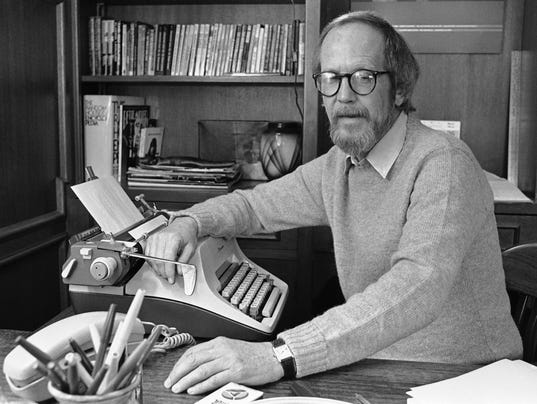
The novelist and screenwriter Elmore John Leonard, Jr., passed away on August 20. His earliest novels, published in the 1950s, were Westerns, but he eventually specialized in crime fiction and suspense thrillers, many of which have been adapted into motion pictures.

In 2001 he outlined his ten rules of writing in The New York Times. They were about fiction, of course, but can we apply them to the more prosaic business of business writing? I think so.

For example, Leonard's second rule is: Avoid prologues. "They can be annoying, especially a prologue following an introduction that comes after a foreword. But these are ordinarily found in nonfiction. A prologue in a novel is backstory, and you can drop it in anywhere you want."

It has come up enough in my experience to be worth mentioning: often the beginning of a nonfiction book turns into a scrum among the first chapter, an introduction and a prologue. Too much stuff that feels introductory or necessary for everything that follows. I follow a simple rule based on absolutely no evidence whatsoever, and that is that I don't trust the reader to read anything before chapter one. So if it's important, put it in something labeled a chapter.

Leonard's fourth rule is to never use an adverb to modify the verb “said.” Well, we can adapt that to: never use an adverb. Make your nouns and verbs do the work. Adverbs are for sissies.

Rule No. 10 is: Try to leave out the part that readers tend to skip. "Think of what you skip reading a novel: thick paragraphs of prose you can see have too many words in them. What the writer is doing, he’s writing, perpetrating hooptedoodle, perhaps taking another shot at the weather, or has gone into the character’s head, and the reader either knows what the guy’s thinking or doesn’t care. I’ll bet you don’t skip dialogue."

So can we all just jettison the hooptedoodle? You know it's there.

"My most important rule, Leonard wrote, "is one that sums up the 10. If it sounds like writing, I rewrite it. Or, if proper usage gets in the way, it may have to go. I can’t allow what we learned in English composition to disrupt the sound and rhythm of the narrative. It’s my attempt to remain invisible, not distract the reader from the story with obvious writing. (Joseph Conrad said something about words getting in the way of what you want to say.)"

Let me rephrase that. If you've just written something, and you think you're ever so clever, and you're preparing your Nobel acceptance speech, delete it immediately before anyone sees it.