Wednesday, October 29, 2014

Walk, then write

Walking on a Country Road, Valerie Jeanne Frischmann
I  often read through the material I will use to write something for a client and then go for my walk. It's a two-mile trek down a quiet side road, beside which there is a stream for a bit.

The ideas enter the thought scrum in my head and take their lumps. I know my work is better for having walked, although I don't charge for the time. A good bit of the work happens on the road.

Here are some things we know about walking and thinking:
What is it about walking, in particular, that makes it so amenable to thinking and writing? The answer begins with changes to our chemistry. When we go for a walk, the heart pumps faster, circulating more blood and oxygen not just to the muscles but to all the organs—including the brain. Many experiments have shown that after or during exercise, even very mild exertion, people perform better on tests of memory and attention. Walking on a regular basis also promotes new connections between brain cells, staves off the usual withering of brain tissue that comes with age, increases the volume of the hippocampus (a brain region crucial for memory), and elevates levels of molecules that both stimulate the growth of new neurons and transmit messages between them.
Moreover, walking in the country is best.
A small but growing collection of studies suggests that spending time in green spaces—gardens, parks, forests—can rejuvenate the mental resources that man-made environments deplete. Psychologists have learned that attention is a limited resource that continually drains throughout the day. A crowded intersection—rife with pedestrians, cars, and billboards—bats our attention around. In contrast, walking past a pond in a park allows our mind to drift casually from one sensory experience to another, from wrinkling water to rustling reeds.
It's said that William Wordsworth—whose poetry is filled with tramps up mountains, through forests, and along public roads—walked as many as a hundred and eighty thousand miles in his lifetime, which comes to an average of six and a half miles a day starting from age five.

Wonder if he charged.

Thursday, October 9, 2014

Getting out of Dodge

You probably give more thought to how you start an article or a speech than you do its ending. But you need to think of both, and in nearly all cases they should relate to each other.

Something positive happens in the reader's mind when at the end he encounters a reference to something from the beginning. For some reason, this recognition gives credence to what you have written. Perhaps simply because it's familiar. Perhaps because the reader feels good about himself for having recognized the repetition.

You can do this in a perfunctory way: quote Shakespeare in the beginning and again in the end, for example. That's not going to buy you much.

Better to do it subtly, to give the reader even more satisfaction from seeing what you're doing. So if you begin with a reference to Sherlock Holmes, you can end with terms like sleuth or mystery or clue or put on your cloak to create an echo of the beginning. No need to mention the old boy by name.

But there's more. In a short story or novel, the ending resolves the conflict the hero dealt with. The reader is relieved that it's over. He celebrates with the hero, if, indeed, the knight prevailed over the dragon. The ending is cathartic.

If your piece is more than just a report on second quarter earnings, you are probably dealing with some kind of conflict. If you aren't, look for it. It may well be the conflict between what you know and what your reader doesn't know. You're bringing your reader to a new point of understanding. In the end, you resolve this.

(And maybe you ought to look at those quarterly numbers as a piece of tension to be resolved. They do tell a story, after all.)

You've been making a  case, laying out your evidence, and now you close in for the kill. You tie it all together, and if you do it well the reader has an epiphany, which is pleasurable.

In his Gettysburg Address, Abraham Lincoln sets up the tension: "But, in a larger sense, we can not dedicate, we can not consecrate, we can not hallow this ground."

In the end, he resolves it: "It is rather for us to be here dedicated to the great task remaining before us — that from these honored dead we take increased devotion to that cause for which they gave the last full measure of devotion — that we here highly resolve that these dead shall not have died in vain — that this nation, under God, shall have a new birth of freedom — and that government of the people, by the people, for the people, shall not perish from the earth."

His words leave us with a profound and sacred challenge.

Wednesday, October 8, 2014

You need to phone it in

Your brilliance.
I read a wide variety of things at night on my cell phone. It's a Samsung Galaxy III, and I can't wait to update to one of the newer, and larger, models.

I've written on this before, but I was reminded the other day when a friend got the new iPhone 6 Plus, their big boy. It slips easily into his pocket. My son got one, too, and he bought a pretty large case for it, so we all had a good laugh when he pulled it out.

Don't laugh. He isn't.

Our previous inexorable laws were: everything that can be digitized will be, and everything that can go wireless will. Today we have to add: anything can fit on a phone, and it will. And you can lie on the couch to read.

So if you're not thinking mobile, you're already behind. For example, I don't read anything with popup ads, because it's just too difficult on my phone. Oh, I see that little X that will make them go away, but try hitting that with your big old fat finger.

Incredibly, some magazines still don't program their websites to adjust for the phone's small screen size. I don't read those, either.

Some sources I'd like to read are just a mess, and I suspect they're a mess on a regular PC, too. Too many graphics, interspersed with ads and overlaid with popups. I don't go there.

Here's the reality.
  • Among all adult Americans, 56 percent reported using a cell phone and 29 percent reported using a tablet to access news in the last week. ~ American Press Institute
  • US consumers spent over 2 hours 19 minutes a day using mobile phones last year – that excludes making calls – matching PC consumption. ~ mobiForge
  • People are reading books on their phones. ~ ebookfriendly
I'm not thinking about advertising at all. I'm thinking about your thought leadership. I know it's a stretch from the elegant, glossy quarterlies and journals we've known in the paper age. But there it is.

Monday, October 6, 2014

Why your writing doesn't work

Your audience.
Yes, you're guilty -- I'm sure of it. I know, because I'm guilty too, and I do this for a living.

The source of bad writing is your assumption that your reader knows as much as you do. Thus sayeth Steven Pinker, a professor of psychology at Harvard University and  chairman of the Usage Panel of the American Heritage Dictionary. He writes in the Wall Street Journal:
Call it the Curse of Knowledge: a difficulty in imagining what it is like for someone else not to know something that you know. The curse of knowledge is the single best explanation of why good people write bad prose. It simply doesn't occur to the writer that her readers don't know what she knows—that they haven't mastered the argot of her guild, can't divine the missing steps that seem too obvious to mention, have no way to visualize a scene that to her is as clear as day. And so the writer doesn't bother to explain the jargon, or spell out the logic, or supply the necessary detail.
Pinker offers three ways to avoid this trap.
How can we lift the curse of knowledge? The traditional advice—always remember the reader over Just trying harder to put yourself in someone else's shoes doesn't make you much more accurate in figuring out what that person knows. But it's a start.

A better way to exorcise the curse of knowledge is to close the loop, as the engineers say, and get a feedback signal from the world of readers—that is, show a draft to some people who are similar to your intended audience and find out whether they can follow it.

Another  way to escape the curse of knowledge is to show a draft to yourself, ideally after enough time has passed that the text is no longer familiar. If you are like me you will find yourself thinking, "What did I mean by that?" or "How does this follow?" or, all too often, "Who wrote this crap?"
But don't go overboard. The curse of knowledge, after all, is job security for us editors.

Thursday, October 2, 2014

Bessie the cow on the ladder of abstraction

Bessie dodges the issue.
Paying attention to the length and complexity of words, as I noted here and here, gives your reader a helping hand in understanding you and, if nothing else, staying awake.

Those posts dealt with the origins of English words, those of Latin derivation being longer and more abstract than those of Germanic origin.

Another way to get at this is a concept known as "the ladder of abstraction," a creation of the American linguist S. I. Hayakawa.

Have you ever experienced writers or speakers who:
  • bury you in an avalanche of data without providing the significance?
  • discuss theories and ideals, completely detached from real-world practicalities?
Each of these is at one end of the ladder. Andrew Dlugan, a speech coach, has a good explanation of the ladder on his website here. He illustrates the idea with Hayakawa's example of a cow named Bessie:
  • wealth (most abstract, top of the ladder)
  • assets
  • farm assets
  • livestock
  • cows
  • the cow named Bessie
  • atoms and molecules forming Bessie (most concrete, bottom of the ladder)
Any of these is appropriate, depending on your context. During a presentation or in a piece of writing you should be moving up and down the ladder, Dlugan says.
Audiences need both concrete details and abstract principles and lessons. To make a persuasive argument and establish a powerful rhythm, balance your speech between the two. Move up and down the ladder (and spend some time in the middle, if appropriate), making your message more understandable for the audience at many different levels.
As you edit and rewrite, ask yourself where each word is on the ladder and decide if that's where you want to be at this point. Are you starting with specifics and then drawing a conclusion from them? Are you starting with a big idea and supporting it with details?

To help you remember to do this, keep the image of Bessie on the ladder in your mind. Go ahead, get it out of your mind. Go ahead.

Wednesday, October 1, 2014

Rot in hell, you lying cheat

My previous post explored Latinate vs Germanic words, the former being generally longer and more complex, and more likely to express abstractions.

Understanding this is critical to effective business writing, and so I want to return to it.

Novelist and marketer Corrine Jackson has written a good piece on this. Anglo-Saxon and Latinate words have a very different sound and feel to them, she writes:
ANGLO-SAXON
  • concrete
  • shorter
  • guttural/blunt
  • “of the body”
  • feeling words
LATINATE
  • abstract
  • polysyllabic
  • elevated diction
  • “of the mind”
  • thinking words
If you are trying to connect emotionally with a reader or audience, your word selection should veer toward the Germanic. Her example:
LATINATE:
“I slept with your best friend,” he said.
“I hope you putrefy in hell, you prevaricating cheat.” she shouted. “I’m glad to be emancipated from you.”
ANGLO-SAXON:
“I slept with your best friend,” he said.
“I hope you rot in hell, you lying cheat.” she shouted. “I’m glad to be free of you.”
I doubt you'll need to express those thoughts in your next white paper, but with this insight you can begin to tailor your message to convey what you intend. As Jackson notes, "Since the reader has to pause and think through the meaning of those multi-syllabic words, you are slowing your reader’s reaction to the scene."

Do you have to know the history of every word? No, but you can see how many syllables a word has and whether it's describing something abstract or concrete.

Check out her list of Germanic and Latinate words here.

Tuesday, September 30, 2014

On selecting the right word

You decide.
If there's one constant difficulty in business writing, it's abstract words.

The concepts we seek to convey are often abstractions, and we have an inclination to use big words, thinking they lend gravitas to our brilliance.

Turns out our readers can sniff this out, and turn us off when they do.

Jamie Reilly, now a professor at Temple University, and his colleagues analyzed more than 2,000 English nouns and found that, to some extent, abstract nouns tend to be longer and more morphologically complex (having more prefixes and suffixes) than concrete ones.

Here's the problem, Jessica Love writes in The American Scholar:
We as English speakers have internalized these differences, and will happily use them to gauge the concreteness or abstractness of strings of letters. And nouns that don’t conform to our ideas about how they should sound—abstract nouns that are short and simple, concrete ones that are long and complex—are understood more slowly than those that meet our expectations.
One possibility is that the two classes of nouns differ etymologically, she writes.
Old English has Germanic origins. But since the 11th century, Latin has also exerted a powerful influence on the language. And beginning in the Renaissance, when it became more acceptable to engage in religious and scientific discourse in one’s own mother tongue, the English language hungrily acquired (and anglicized) a swath of Latin terms wholesale. English writers have long played the distinctive properties of Latinate and Germanic words against each other.
In a 1984 essay, historian Jacques Barzun makes the explicit observation that Latinate words tend to be more abstract than even their nearest Germanic equivalents. The English language, he writes, “possesses two vocabularies, nearly parallel, which carry the respective suggestions of abstract and concrete, formal and vernacular. A writer can say concede or give in; assume or take up; deliver or hand over; insert or put in; retreat or fall back.” Indeed, in tracking down the etymology of those 2,000 English nouns, Reilly and his colleagues find that abstract ones tend to be Latinate, while concrete ones have a wider range of etymological origins—most commonly Germanic.
There it is. We have the choice. The only rule is that our readers must understand us, and our selection words must not interfere.

Friday, September 26, 2014

Defanging a cliche

From Orin Hargraves' new book, It's Been Said Before: A Guide to the Use and Abuse of Clichés, via Lynn Gaertner-Johnston, we see how to clean up common cliches.

These edits dissolve the clichés, eliminate words, and make the writing stronger. Clichés dull our comprehension. First, the brain has to decipher extra words. Second, because it's seen the cliché a thousand times, the brain gets lazy. They turn crisp writing into slop.

Look for these opportunities to de-slop your writing:

very real
absolutely nothing
generally tend
entirely possible
perfectly normal
general consensus
freely admit
distinct advantage
close proximity
abundantly clear
abject failure
in actual fact
the fact of the matter is
know for a fact
know full well
fully intend
a world of difference
a palpable sense
proven track record
in any way, shape, or form
as a general rule of thumb
more often than not

Tuesday, September 23, 2014

How your audience reads your words

Your future reader.
This isn't good news for those who write sentences and paragraphs about serious ideas.

Screens have changed our reading patterns from the linear, left-to-right sequence of years past to a wild skimming and skipping pattern as we hunt for important words and information, Jean Whalen writes.
One 2006 study of the eye movements of 232 people looking at Web pages found they read in an "F" pattern, scanning all the way across the top line of text but only halfway across the next few lines, eventually sliding their eyes down the left side of the page in a vertical movement toward the bottom.

None of this is good for our ability to comprehend deeply, scientists say. Reading text punctuated with links leads to weaker comprehension than reading plain text, several studies have shown. A 2007 study involving 100 people found that a multimedia presentation mixing words, sounds and moving pictures resulted in lower comprehension than reading plain text did.
Ferris Jabr elaborates in Scientific American:
Evidence from laboratory experiments, polls and consumer reports indicates that modern screens and e-readers fail to adequately recreate certain tactile experiences of reading on paper that many people miss and, more importantly, prevent people from navigating long texts in an intuitive and satisfying way. In turn, such navigational difficulties may subtly inhibit reading comprehension.
My experience with the instructions business website editors give to writers is that they desire short and punchy copy with copious subheads and lists. It's as though they know their readers don't have much patience for reading.

Do we who dwell in the land of serious, thoughtful business writing yield to this? I think not. However, we might anticipate the divergence of our audience into those who are comfortable with the slow, orderly development of ideas and those who are need listy sound bites. Then plan to please both.

Wednesday, September 17, 2014

Help your audience stay awake

You tell 'em!
If you stand in front of your audiences and drone on about whatever it is you do, you're in good company.

The "sage onstage" model in education is as old as universities, which got going around 1050, and this approach has generally been in use as long one person thought he knew more than another one and got up to try to prove it.

So that would take in some of your old guys like, say, Aristotle.

However, it's not always the best way. Biologist Scott Freeman of the University of Washington, Seattle, analyzed 225 studies of undergraduate STEM teaching methods.
The meta-analysis concluded that teaching approaches that turned students into active participants rather than passive listeners reduced failure rates and boosted scores on exams by almost one-half a standard deviation. “The change in the failure rates is whopping,” Freeman says. And the exam improvement -- about 6% -- could, for example, “bump a student’s grades from a B– to a B.”
I don't see why this wouldn't apply to a business environment. 
Although there is no single definition of active learning approaches, they include asking students to answer questions by using handheld clickers, calling on individuals or groups randomly, or having students clarify concepts to each other and reach a consensus on an issue.
Freeman says he’s started using such techniques even in large classes. “My introductory biology course has gotten up to 700 students,” he says. “For the ultimate class session -- I don’t say lecture -- I’m showing PowerPoint slides, but everything is a question and I use clickers and random calling."

Fine, but can you skip the PowerPoint.


Tuesday, September 16, 2014

Will your writing last 100 years?

Held up well.
Most academics spend much of their time writing but aren't as good at it as they should be, Michael C. Munger, chairman of political science at Duke University, says.

In The Chronicle of Higher Education, in an article  titled "How To Write Less Badly," he offers some insight that is applicable far beyond the ivy-covered red bricks.

This article pulled me up short. I've been cranking it out for so many years I think I may have lost sight of the reason I got into this game in the first place.

Here he is:
1. Set goals based on output, not input. "I will work for three hours" is a delusion; "I will type three double-spaced pages" is a goal. After you write three pages, do something else. If later in the day you feel like writing some more, great. But if you don't, then at least you wrote something.

2. Find a voice; don't just "get published." James Buchanan won a Nobel in economics in 1986. One of the questions he asks job candidates is: "What are you writing that will be read 10 years from now? What about 100 years from now?" Someone once asked me that question, and it is pretty intimidating. And embarrassing, because most of us don't think that way. We focus on "getting published" as if it had nothing to do with writing about ideas or arguments. Paradoxically, if all you are trying to do is "get published," you may not publish very much. It's easier to write when you're interested in what you're writing about.

3. Give yourself time. Many smart people tell themselves pathetic lies like, "I do my best work at the last minute." Look: It's not true. No one works better under pressure. Sure, you are a smart person. But if you are writing about a profound problem, why would you think that you can make an important contribution off the top of your head in the middle of the night just before the conference?

Writers sit at their desks for hours, wrestling with ideas. They ask questions, talk with other smart people over drinks or dinner, go on long walks. And then write a whole bunch more. Don't worry that what you write is not very good and isn't immediately usable. You get ideas when you write; you don't just write down ideas.

The articles and books that will be read decades from now were written by men and women sitting at a desk and forcing themselves to translate profound ideas into words and then to let those words lead them to even more ideas. Writing can be magic, if you give yourself time, because you can produce in the mind of some other person, distant from you in space or even time, an image of the ideas that exist in only your mind at this one instant.
There's more at the link.

Monday, September 15, 2014

Nothing incorrect in his words

"A superior man, in regard to what he does not know, shows a cautious reserve. If names be not correct, language is not in accordance with the truth of things. If language be not in accordance with the truth of things, affairs cannot be carried on to success. When affairs cannot be carried on to success, proprieties and music do not flourish. When proprieties and music do not flourish, punishments will not be properly awarded. When punishments are not properly awarded, the people do not know how to move hand or foot. Therefore a superior man considers it necessary that the names he uses may be spoken appropriately, and also that what he speaks may be carried out appropriately. What the superior man requires is just that in his words there may be nothing incorrect."

~ Confucius

Wednesday, September 3, 2014

Persuading someone to meet with you

As a journalist I have been getting meetings with people for so long I have to stop and think of the techniques I use. It doesn't hurt if you're representing, as I used to be, an international wire service or magazine.

Dorie Clark sums up the rules for being effective:
If you’re asking someone you don’t know for a half-hour, or even 10 minutes, you have to think of your request like you’re making a VC pitch. Why should they speak to you? How can you establish your credibility upfront? How will it benefit them? How can you pack the greatest ROI into the shortest time?
This sounds remarkably like the rules for persuading people in a speech or an article:
  • Understand your audience
  • Know what they need or want
  • Offer it to them
Those people you want to meet? Everyone else wants to meet them, too, meaning you have to give them a reason to see you. They want to know: what's in it for me?

Here's one of those people. Steve Blank is an entrepreneur and academic in Silicon Valley. You can read what he thinks about requests for his time here. The bottom line for him? "Who is offering to teach me something I don’t know?"

So instead of what you want, you have to start with what the other person wants. You have to do your homework. If you don't have anything to offer you might want to rethink your reason for wanting a meeting in the first place.

Monday, August 25, 2014

How to be persuasive in meetings

Your ability to persuade others is regularly tested in meetings. I always found them puzzling, perhaps because they aren't rational -- and aren't supposed to be.

You would think that simply presenting an interesting idea, and some rationale for it, would be enough. Nope. That's not even the point.

Meetings are social events. They are about power and hierarchy, and sometimes just fooling around. Many meetings are called just to show the people summoned to them that the person calling them has the power to do so. Many meetings are held, because, you know, "we always meeting Monday." I'm sure that behind many meetings is the stifling boredom pervading most offices and cubicles.

More important than any of the PowerPoints tossed around the room is the body language of the tossers and tossees. If you don't know how to spot the alpha, you won't get groomed.

Watch some videos of gorillas or other primates hanging around and interacting. You can learn a lot about human meetings this way.

With all that cynicism as a backdrop, let me share some thoughts from Kathryn Heath, Jill Flynn, and Mary Davis Holt, partners at a consulting firm focused on women’s leadership development. Their article in Harvard Business Review addresses women in meetings, but their understanding of these occasions is what I'm interested in here.

For example:
The premeeting. Our research shows that female executives come to meetings on time. They leave as soon as the last agenda item has been completed, rushing off to the next meeting or heading back to their offices to put out fires. We’ve found that men are more likely to spend time connecting with one another to test their ideas and garner support. They arrive at meetings early in order to get a good seat and chat with colleagues, and they stay afterward to close off the discussion and talk about other issues on their minds.
It's a social event. There's more:
Meetings before the meeting. Women need to get in on what several men described as the “meetings before the meetings,” where much of the real work happens. Participating in these informal advance conversations can help clarify the true purpose of a meeting, making it much easier to take an active part in the conversation. Will the group be asked to make a decision? Confirm a consensus? Establish power? It’s often not apparent in the official agenda.
There's more in the article.  Or you can just watch these executives conduct a meeting here.

Thursday, August 21, 2014

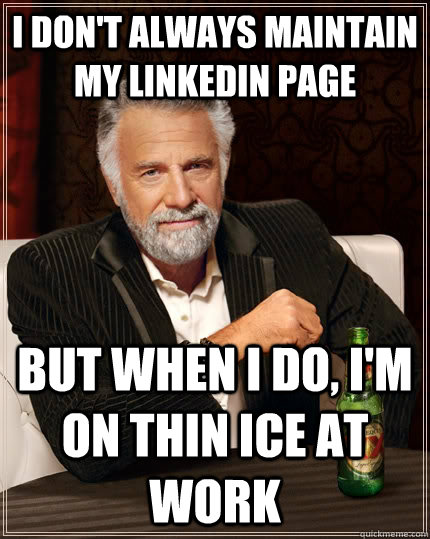
Don't use these words on your LinkedIn profile

Or on your resume, or in the john, or in the backyard talking to your chickens.

You already know this because you've read all those profiles using them and you just want to gag yourself with a spoon, right?

Do this little test: read five LinkedIn profiles at random and see if you have really learned something about the person. If you haven't, it may be due to their use of bad words.

That's right, these words are just bad, bad, bad. Don't even think about going near them.

Another test: see how many of these words appear in a person's summary. Pass me that spoon, please.

Aaron Taube at Business Insider has collected these.

1. I — Who else's profile would it be?
2. Me — See above.
3. My — See above.
4. She — Only narcissists speak in the third person.
5. He — See above.
6. Salary — Never list it unless an employer asks.
7. Go getter — Jargon.
8. Synergy — Jargon.
9. People pleaser — Jargon.
10. Self starter — Jargon.
11. Strategic — Overused.
12. Creative — Overused.
13. Effective — Overused.
14. Expert — Only if you really are.
15. Driven — Overused.
16. Innovative — Overused.
17. Analytical — Overused.
18. References — If they want them, they'll ask. Otherwise you're just wasting space.
19. w/ — Spell it out to look professional.
20. Extensive — Overused and unnatural.
21. Ninja — Annoying/meaningless.
22. Diva — Annoying/meaningless.
23. Dedicated — Boring.
24. Detail oriented — Who isn't?
25. Passionate — If you are, it will come through without your explicitly saying so.
26. Entrepreneurial — Overused.
27. Skill set — Overused.
28. Dynamic — What does this even mean?
29. Intense — Can make you sound unpleasant to work with.
30. People person — They'll know when you come in for an interview.
31. Problem solver — Avoid unless you have clear-cut examples.
32. Team player — Overused.
33. Track record — Your track record should be apparent in your profile.

Sign into LinkedIn and see what you can do. This stuff isn't easy.

Tuesday, August 12, 2014

A writer's life

"A couple of years ago, while trying to make a name for myself as a writer, I ghost-wrote a number of true crime autobiographies."

~ Nick Chester, Vice.com, Aug. 8

Let's go on a noun hunt

You can shoot as many as you want.

A sentence needs one noun and one verb. That's it. Next time you write a sentence count the nouns in it.

For some reason we like to turn verbs and adjectives into nouns. This is called nominalization. Maybe we think it sounds more important.

It doesn't; it just confuses. Compare these two passages from George Orwell's Politics and the English Language:
I returned and saw under the sun, that the race is not to the swift, nor the battle to the strong, neither yet bread to the wise, nor yet riches to men of understanding, nor yet favour to men of skill; but time and chance happeneth to them all.
Here it is in modern English:
Objective considerations of contemporary phenomena compel the conclusion that success or failure in competitive activities exhibits no tendency to be commensurate with innate capacity, but that a considerable element of the unpredictable must invariably be taken into account.
Academics fall prey to nominalization. So do business writers. Perhaps it's because business writing is often about abstract concepts.
An accreditation analysis was conducted of the performance level of the administration of the senior executive compensation disbursement mechanism.
This would be much clearer by inserting some prepositions and verbs:
the mechanism for disbursing compensation to senior executives
You can make your writing a lot stronger by counting the nouns in a sentence and getting rid of as many as possible. Here's an example from Helen Sword, who teaches at the University of Aukland:
The proliferation of nominalizations in a discursive formation may be an indication of a tendency toward pomposity and abstraction.

The sentence above contains no fewer than seven nominalizations, each formed from a verb or an adjective. Yet it fails to tell us who is doing what. When we eliminate or reanimate most of the zombie nouns (tendency becomes tend, abstraction becomes abstract) and add a human subject and some active verbs, the sentence springs back to life:

Writers who overload their sentences with nominalizations tend to sound pompous and abstract.
Don't be pompous and abstract.

Friday, August 1, 2014

Tell a story with your sentences

A story in six words.
In my last post, I explored the use of conflict to put energy into business writing.

I've just come across a fascinating idea: that individual sentences can introduce tension and tell little stories.

This comes from Constance Hale, an accomplished writer who wrote a series of instructional pieces for the New York Times on sentences. In the first piece, she writes:
For a sentence to be a sentence we need a What (the subject) and a So What (the predicate). The subject is the person, place, thing or idea we want to express something about; the predicate expresses the action, condition or effect of that subject. Think of the predicate as a predicament — the situation the subject is in. 
I like to think of the whole sentence as a mini-narrative. It features a protagonist (the subject) and some sort of drama (the predicate):The searchlight sweeps. Harvey keeps on keeping on. The drama makes us pay attention.
She draws from novels to illustrate her point:
  • “They shoot the white girl first.” — Toni Morrison, Paradise
  • “Elmer Gantry was drunk.” — Sinclair Lewis, Elmer Gantry
  • “Every summer Lin Kong returned to Goose Village to divorce his wife, Shuyu.” — Ha Jin, Waiting
Let's look for examples in the business world:
  • Foreign intelligence services from China, Russia, and other nations are exploiting cyber vulnerabilities to steal technology, money, and trade secrets from US corporations, threatening their reputations and undermining their competitive advantage. ~ Booz Allen Hamilton
  • Does mobile commerce spell the end of traditional stores? ~ McKinsey
  • As Europe continues to grapple with sovereign debt problems, austerity measures, and recession, the Eurozone is changing and will likely emerge from the ongoing crisis looking quite different from the one we know today. ~ Price Waterhouse Coopers
These are wordy, of course, but they suggest how individual sentences can introduce drama into otherwise staid writing.